China’s industrial robot base and manufacturing ecosystem give it a substantial head start as it moves towards AI-powered robots
India’s robot adoption and manufacturing ecosystem are growing, but the gap is primarily of scale, speed, capital and supply chains
For India, the opportunity may not be to beat China immediately, but to become a strong alternative by rapidly building its own ecosystem
China Is Building Humanoids, Can India Be The First Follower In Manufacturing, AI And Robots?
China’s robotics industry has more than 150 humanoid companies, while India has only handful. With China building its manufacturing base for last few years, experts say India's first focus should be on being the first follower

How China’s Humanoid Push Challenges India’s Manufacturing Ambitions AI generated representative image
Summary
Advertisement
China’s humanoid robot push may look like a race for machines that can run, box or play football. But beneath the spectacle is a larger industrial contest: Who can combine manufacturing scale with artificial intelligence to build the next generation of factories?
The question matters for India because its own manufacturing ambitions are gathering momentum just as China moves from conventional factory automation towards robots equipped with AI.
At the World Humanoid Robot Games in Beijing, China’s Tiangong Ultra ran 100 metres in 8.64 seconds, faster than Usain Bolt’s 9.58-second human world record. More than 2,000 robots from 666 teams took part across 51 events.
Yet the bigger story is outside the stadium. In the factories.
China’s Head Start In Factory Automation
China has spent decades building its manufacturing base and automating factories. According to the International Federation of Robotics (IFR), China had 2.027 million industrial robots operating in factories in 2024, while 295,000 new robots were installed that year, accounting for 54% of global installations.
Advertisement
India, by comparison, installed 9,123 industrial robots in 2024, taking its operational stock to about 52,600, according to the IFR.

The difference is not merely about technology, it also comes down to the discipline in manufacturing, Dr Rajesh Kumar, Principal Scientist for Robotics & AI at robot manufacturing firm Addverb, told Outlook Business.
"My understanding is that there is obviously a tremendous gap in how quickly and also with what quality things can be built," he said, adding that China’s advantage comes from an ecosystem developed over many years.
"But from the manufacturing space, I don't think there is a capability gap. It's more of a volume, speed of execution and ecosystem gap, as well as large-scale disciplined manufacturing," Kumar said.
China Now Adding AI To That Industrial Base
Last year, the global humanoid shipments reached about 20,000 units, with Chinese manufacturers accounting for 95%, according to BofA Global Research report, cited by Reuters.
Advertisement
China’s next step is to bring AI into physical machines. Its 2026-2030 15th Five-Year Plan places robotics and AI-powered physical systems at the centre of manufacturing modernisation, while the government has also promoted its “AI Plus” strategy.
China’s Ministry of Industry and Information Technology expects the country to produce more than 100,000 humanoid robots this year, state news agency Xinhua reported in July.

But production is moving faster than deployment. A Reuters report found that humanoids at a Chinese training facility were slow and unreliable at basic tasks.
Industry executives and researchers told the news agency that the machines still struggle with situations requiring intuition and deviations from programmed routines.
According to Kumar, this distinction is crucial because "if the cognitive ability is not present, then the human form factor loses its value."
For now, conventional robotic arms can be more useful because they can perform specialised tasks consistently, he said, pointing out that China, however, has the ability to keep experimenting at a scale that India cannot easily match.
Advertisement
Why India Can't Simply Replicate China?
The answer lies in the robotics ecosystem of both the countries. China’s robotics industry has more than 150 humanoid companies, according to the Reuters report, with governments providing subsidies, procurement support and training infrastructure.
Chinese government entities spent at least $230 million on humanoids and related items in the first half of 2026, the report said.
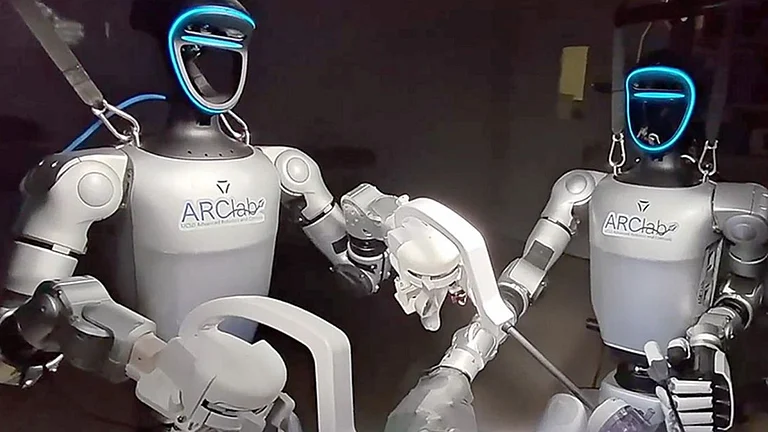
Kumar said this willingness to let numerous companies experiment is important. "You see this the World Robotics Conference, there are 900 robots running, and they are not just mobile companies building robots. It's everywhere and people are failing. And they don't worry."
India, he says, needs to create conditions where smaller companies can also take those risks. "So, just building products, robots, robots, robots, massively, should be incentivised in some sense," he argued.
The difference is particularly important because Indian startups cannot afford to spend years producing unsuccessful machines without a clear path to funding or customers.
Advertisement
India’s Component Gap Adds To Challenge
Indian humanoid makers remain dependent on overseas supply chains for several critical components.
Muhammed Azhar, Co-founder of robotics manufacturing company Autobonics, told Outlook Business that almost 99% of Indian humanoid manufacturing companies, are dependent on China or some other country for various parts that are needed to build robots.
"Microcontrollers and several other core components are largely sourced from China, while certain camera technologies come from Japanese and German companies," Azhar said.

The manufacturing of Printed Circuit Boards (PCB), which provide the structural support to the body, illustrates the cost disadvantage, he said, with Indian production taking longer and costing considerably more.
Hence, for smaller companies, "buying ready-made components is often the only financially viable option," Azhar said, adding that India can develop the ecosystem as well but "all this will require huge funding."
He argued that India therefore needs to build the layers beneath the final robot — sensors, actuators, electronics and related technologies — rather than focusing only on finished humanoids.
India Has Started Building The Base
India’s manufacturing push is not starting from zero. Ministry of Commerce and Industry's data showed that PLI schemes across 14 sectors had attracted more than ₹2.16 lakh crore of investment by December 2025, generating more than ₹20.41 lakh crore in cumulative production and sales and over ₹8.3 lakh crore in exports.
The government has also disbursed ₹15,554 crore under the electronics PLI schemes and ₹2,377.56 crore under the automobile and auto-components scheme.
But robotics needs a deeper ecosystem. Kumar believes India needs dozens more companies competing simultaneously, while Azhar argues that universities and research institutions need greater support for core technologies.

The opportunity, therefore, may not be to overtake China immediately. It may be to become a credible alternative.
Kumar raised an interesting question of whether India can become the leading follower instead. "Can India become the first follower? Can India demonstrate in 2028 what China is demonstrating in 2026? Can we just be two years behind?" he remarked.
For India, that gap could determine whether its manufacturing push merely creates more factories — or develops the technology to automate and compete in them.