Lakshmi Venu and Mallika Srinivasan say no wealth settlement has been reached in the family.
They say the 2020 partition and 2024 MoU do not divide ownership.
No deal had been announced as of October 13.
TVS Group’s Ownership Question Is Far From Settled
Mallika and Lakshmi call the existing arrangements unilateral and not the product of mutual agreement. Their demand is a resolution built on valuation, discussion and agreement among those concerned

TVS Family
Summary
Advertisement
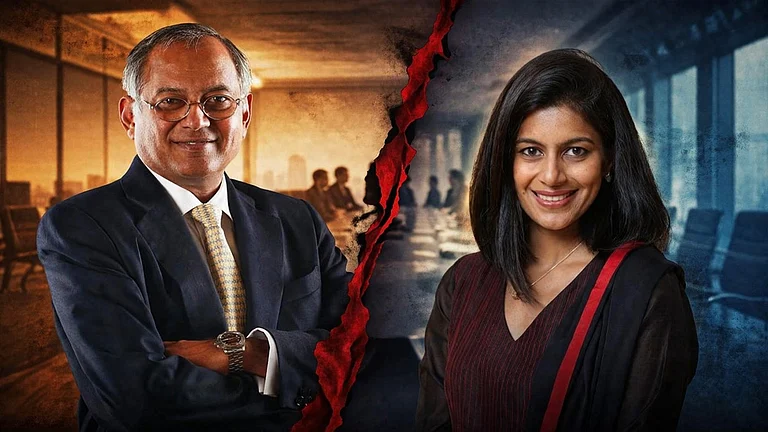
Who owns what in the TVS Group? That is the question at the centre of a family dispute that remains unresolved. On Monday, Lakshmi Venu and her mother Mallika Srinivasan said that no economic settlement has been reached within the Venu Srinivasan family, countering suggestions that the division of assets is complete. They want a fair and transparent process to settle the matter.
On the other side are Venu Srinivasan and his son Sudarshan Venu, whose camp has maintained that arrangements already split responsibilities and businesses between the two children. As of October 13, the family has announced no deal.
Who Is Who In The Family
Venu Srinivasan, chairman emeritus of TVS Motor Company, took charge of Sundaram-Clayton in 1979 and helped turn the family’s auto business into a major name in two-wheelers. He is also vice-chairman of the Tata Trusts and a nominee director on the board of Tata Sons, the Tata Group’s holding company.
Advertisement
His son Sudarshan is chairman and managing director of TVS Motor. His daughter Lakshmi is vice-chairperson of Tractors and Farm Equipment Ltd (TAFE) and has been associated with Sundaram-Clayton. His wife Mallika is chairperson and managing director of TAFE, the tractor maker.
Running A Company Versus Owning It
The disagreement comes down to what the arrangements of recent years truly achieved. Did they divide the family’s wealth, or only decide who leads which business and who holds rights over the group’s brands?
Venu Srinivasan’s side points to a split of roles. Sudarshan has been linked with TVS Motor and TVS Holdings, while Lakshmi has been linked with Sundaram-Clayton and other ventures. Mallika and Lakshmi do not accept that this settles ownership. In their joint statement, they said the family’s economic interests, meaning the stake in the value and earnings of the businesses, have not been divided through transparent valuation, discussion and mutual consent. They also rejected the notion that all family assets belonged to one person who could hand them out on his own.
Advertisement
A person can run a company without holding much of it, and can hold a stake without running anything. Their stance is that management roles and chances to lead cannot stand in for ownership rights.
What 2020 Partition And 2024 MoU Cover
Two earlier agreements complicate the picture. A wider TVS family partition, which means a division of jointly held family assets, was agreed in 2020 and carried out afterwards. Mallika and Lakshmi said that exercise involved the relevant stakeholders, but that nothing comparable has taken place within the Venu Srinivasan family.
The second document is a memorandum of understanding (MoU) signed in March 2024. By their account, it dealt with brand rights, trademark use and related obligations such as non-compete terms, which restrict a party from competing in certain areas of business. It was not a final settlement of ownership or wealth, they said.
Advertisement
So the argument is about reach. How far do these agreements go, and do they amount to a final division of economic interests? Mallika and Lakshmi call the existing arrangements unilateral and not the product of mutual agreement. Their demand is a resolution built on valuation, discussion and agreement among those concerned.
Why TAFE Keeps Coming Up
TAFE enters the debate because Mallika leads it. She and Lakshmi said the company belongs to the Amalgamations Group, a separate family business group in which Mallika is a shareholder. It has no bearing on the economic settlement within the Venu Srinivasan family, they said, and should not be mixed up with it.
They also objected to the use of her long association with TAFE as evidence of an equitable split of the family’s assets, calling that framing “fundamentally misleading”.