Fuel now makes up 55-60% of airline operating costs, squeezing margins sharply.
FIA has sought urgent government support, warning of aircraft grounding and flight cancellations.
Air India is cutting international flights as ATF hikes and longer routes make operations unprofitable.
Turbulence Ahead: How Soaring ATF Prices Are Pushing Indian Airlines to the Brink
Faced with mounting losses, the Federation of Indian Airlines (FIA), which represents major carriers including SpiceJet, wrote a strongly-worded letter to the Civil Aviation Ministry on April 26, urging the government to step in with immediate financial support

Aviation Turbine Fuel Shutterstock
Summary
Advertisement
India's aviation sector is facing one of its most severe cost crises in recent memory. Fuel, which once accounted for 30-40% of an airline's total operating expenses, now makes up 55-60% of costs. This is an overwhelming increase that has left carriers with little room to manoeuvre.
The trigger is no mystery. The ongoing conflict in West Asia has disrupted global oil supply chains, pushed crude prices past $125 per barrel, and forced airlines operating international routes to take longer detours, burning even more fuel in the process. For a sector still finding its footing after the pandemic, the timing could not be worse.
Airlines Cry Foul, Write to Govt
Faced with mounting losses, the Federation of Indian Airlines (FIA), which represents major carriers including SpiceJet, wrote a strongly-worded letter to the Civil Aviation Ministry on April 26, urging the government to step in with immediate financial support.
"Any ad hoc pricing (domestic vs international) and/or irrational increase in the price of ATF will result in insurmountable losses for airlines and will lead to grounding of aircraft, resulting in cancellation of flights," the FIA warned.
Advertisement
"In order to survive, sustain and continue operation, we request your urgent intervention for immediate and meaningful financial support to tide over the current situation," it further stated.
The letter reflects the desperation of an industry that sees itself hurtling toward a cliff edge, with airline executives warning that without government intervention, aircraft could be grounded and passengers left stranded.
Notably, not all airlines have been hit equally. State-owned oil major Indian Oil Corporation (IOC) confirmed on May 1 that ATF prices for scheduled domestic airlines had not been revised, offering some breathing room to carriers like IndiGo and SpiceJet, which operate predominantly within India. International ATF prices, however, were hiked by $76.55 per kilolitre, taking the rate to $1,511.86 per KL from $1,435.31 per KL. For airlines flying abroad, this is a punishing increase.
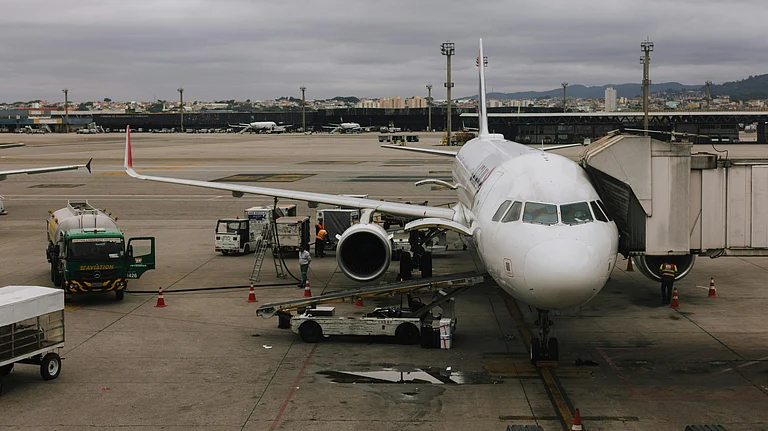
Air India Takes the Hardest Hit
No carrier has felt the pinch more acutely than Air India, which runs a large international network. The airline's CEO and Managing Director, Campbell Wilson, confirmed that the airline has already pulled back on international flights for April and May, and will be forced to trim its schedule further into June and July.
Advertisement
Speaking directly to staff, Wilson explained the bind the airline finds itself in: "Massive rise in jet fuel prices which, together with airspace closures and longer flying routes, have caused many of our international flights to become unprofitable to operate."
The airspace closures, a direct consequence of the West Asia conflict, have forced Air India to reroute many international flights over longer paths. Wilson, who has announced plans to step down later this year, said the situation remains "extremely challenging" and expressed hope that the geopolitical crisis would ease.
"We very much regret the disruption to our customers' plans and our crew's rosters, and hope that the Middle East situation settles - and the Strait of Hormuz opens - soon so that we can get back to a more normal state," he said.
It's not just airlines feeling the heat. Oil marketing companies are currently selling petrol and diesel at a loss, around ₹14 per litre on petrol and ₹18 per litre on diesel, as elevated global crude prices outpace the rates at which they can sell fuel domestically.
Advertisement
Petrol is currently priced at ₹94.77 per litre in New Delhi and ₹103.50 per litre in Mumbai. Diesel is retailing at ₹87.67 per litre in the capital and ₹90.01 per litre in Mumbai.
Government's Response
The government has been walking a tightrope, trying to protect domestic fuel availability while managing fiscal pressures. The Ministry of Finance, in a notification effective May 1, set the export duty on Aviation Turbine Fuel at ₹33 per litre, down from ₹42 per litre in the previous fortnight (April 11). Export duty on diesel was fixed at ₹23 per litre.
Crucially, the government has made clear that domestic excise duties on petrol and diesel have not changed. This follows an earlier ₹10 excise duty cut announced in early March, when crude prices first began climbing sharply after the onset of the US–Iran conflict.
Advertisement
At an inter-ministerial briefing, Joint Secretary in the Ministry of Petroleum and Natural Gas, Sujata Sharma, sought to reassure the public, stating: "LPG, petrol, and diesel are available in sufficient quantities and prices have not increased, so please do not panic." She also confirmed that the government currently has no plans to revise domestic fuel prices.
The government's export duty mechanism is primarily aimed at ensuring adequate domestic fuel supply amid the ongoing supply chain disruptions, a concern that takes precedence for now over providing relief directly to airlines.
A Sector at Crossroads
The stock market has already begun reflecting investor anxiety. Shares of SpiceJet were trading 4.01% lower at ₹12.20, while Interglobe Aviation, the parent of IndiGo, saw its shares fall by ₹26.20 to ₹4,229.40.
India's aviation sector has long been a high-cost, low-margin industry. In this environment, a prolonged fuel crisis could force smaller carriers to ground aircraft, reduce routes, or pass on costs to passengers through higher ticket prices.
The path forward depends largely on how quickly the situation in West Asia stabilises. Until crude prices ease and airspace restrictions lift, India's airlines will continue to fly through serious financial turbulence, hoping the government throws them a lifeline before the engines sputter out.