Two bread manufacturers have been penalised within a week for advertising their products as “100% Whole Wheat Bread”, bringing renewed attention to the gap between what food labels promise and how companies explain those claims.
The Business Behind '100%': Why Food Labels Promise More Than They Explain
Successive penalties against food companies have renewed questions about how products are marketed, what consumers understand from packaging and whether existing regulations are being enforced effectively

Bread Magnific
Advertisement
On October 22, the Central Consumer Protection Authority (CCPA) imposed a ₹1 lakh penalty on Britannia Industries after finding that whole wheat flour accounted for around 62% of its finished bread, despite the prominent “100% Whole Wheat” claim. Six days later, the consumer watchdog imposed a similar penalty on Sunrise Foods, whose Everyday bread contained 64% whole wheat flour by finished-product weight.
Both companies argued that their claims referred to the flour used in the bread rather than the entire finished product. However, the CCPA rejected the explanations, finding that the packaging could mislead ordinary consumers about what they were purchasing.
The cases have brought into focus a larger issue in India's packaged-food market: how far can companies go in promoting a product's ingredients or nutritional qualities before the claim becomes misleading?
The controversy also comes amid a wider regulatory push against absolute food claims, even as companies and regulators disagree over how the existing rules should be interpreted and enforced.
Advertisement
When '100%' Does Not Mean the Entire Product
The distinction between a product's ingredients and its overall composition lies at the centre of the two recent cases.
In Britannia's case, the company maintained that its bread was made using whole wheat flour without refined wheat flour, commonly known as maida. It argued that the “100%” claim referred specifically to the flour component.
The packaging also carried a qualification stating that the bread was made from 100% whole wheat flour on a flour basis. However, the CCPA found that the smaller disclosure did not adequately clarify the prominent claim on the front of the pack.
A similar defence was presented by Sunrise Foods. According to the company's submissions reported in the CCPA proceedings, whole wheat flour constituted 96.3% of its flour-related inputs, while the finished bread contained 64% whole wheat flour by weight.
The two percentages measure different things. The first refers to the proportion of whole wheat within the flour inputs, while the second measures its share of the finished product, which also contains other ingredients.
Advertisement
Under FSSAI's Labelling and Display Regulations, bread described as “Whole Wheat Bread” must contain at least 75% whole wheat flour on a flour basis. This is different from requiring whole wheat flour to make up 75% of the finished loaf's weight.
The CCPA's findings against the two manufacturers therefore need to be understood in the context of both the applicable compositional requirements and the overall impression created by the packaging. A finished-product percentage alone does not establish whether the separate flour-basis threshold has been met.
For consumers, however, these distinctions may not be immediately apparent.
Avanish Agarwal, food educator and content creator, said the wording on the front of a packet can lead shoppers to make assumptions about the entire product.
“The distinction is technical, but it can be explained simply: ‘all the flour used is whole wheat’ and ‘the entire loaf is whole wheat’ are different statements,” he said.
Advertisement
He added that bread also contains ingredients such as water and yeast, and their presence does not automatically indicate adulteration or poor nutritional quality.
According to Agarwal, the problem arises when consumers are expected to understand a technical calculation that is not clearly explained alongside the claim.
“I would not expect a shopper to work out what a bold percentage is being calculated against,” he said.
The Sunrise case also raised questions about the removal of disputed packaging from online marketplaces.
During an October 23 hearing, the CCPA reportedly found the earlier packaging displaying the “100%” claim on Blinkit and Zepto, despite Sunrise Foods' submission that it had withdrawn the disputed version.
The company maintained that it had approved revised packaging without the absolute claim and argued that third-party platforms independently maintained their product listings. The authority did not accept that explanation as sufficient to absolve the company of responsibility for the continuing representation.
Advertisement
The episode highlights a further compliance challenge: changing packaging or advertising material may not immediately remove an earlier claim from every platform where a product is sold.
Why Food Brands Rely on Absolute Claims
For food companies competing for consumer attention, claims such as “pure”, “natural” and “whole wheat” can communicate product benefits more quickly than detailed ingredient information.
Richa Khandelwal, Founder and Managing Director of Leads Brand Connect, which works with Indian and international food brands, said packaging plays an important role in influencing purchasing decisions.
“Claims such as ‘100% Pure’, ‘Natural’ and ‘Whole Wheat’ communicate a product promise almost instantly. They simplify decision-making, create a perception of quality and help consumers distinguish between products on a crowded retail shelf,” she said.
Such claims can be particularly effective in food categories where consumers may not be able to evaluate a product's sourcing, processing or composition before purchasing it.
However, the wording is only one part of the communication. Packaging design can also influence what shoppers understand.
Krishnaprasad Balakrishnan, Executive Creative Director at PRHUB, said consumers often spend only a few seconds examining a product before making a decision.
“The brain processes size, colour and contrast before it processes words. A bold ‘100% Pure’ works as a headline, so it becomes the belief the shopper walks away with,” he said.
By comparison, ingredient lists and nutritional information often appear in smaller text and require more effort to interpret.
“Responsible brands treat the front of the pack as a promise and the back as proof, and make sure the two agree,” Balakrishnan said.
Agarwal said prominent claims can also create what is commonly described as a “health halo”, where one positive feature shapes perceptions of the entire product.
“‘Natural’ does not tell you how much sugar a product contains. ‘Pure’ does not tell you whether it is low in salt or saturated fat. Even a genuine whole-wheat claim does not replace the need to look at the overall nutritional profile,” he said.
This distinction matters because a product's composition, its nutritional quality and the way it is advertised are related but separate questions.
Where Do India's Food Labelling Rules Stand?
The recent penalties are not isolated regulatory actions.
In June, the CCPA imposed penalties of ₹1 lakh each on Mrs Bectors Food Specialities, which markets English Oven, and Storia Foods and Beverages over misleading “100%” claims.
In an order dated June 9, the authority examined English Oven advertisements using expressions such as “100% Atta Bread” and “100% Whole Wheat Bread”. The company argued that the claims referred to the flour used in its products, but the regulator rejected the defence.
The separate June 18 order against Storia concerned “100% Tender Coconut Water”, “100% Natural Tender Coconut Water” and “100% Juice” claims on its beverage products.
The CCPA found that the coconut-water product was made using water and coconut water concentrate, with the reconstituted nature of the beverage disclosed in smaller print. It also examined the ingredient declarations of several juice variants.
Both companies were directed to discontinue the misleading claims.
The regulatory action followed a May 28, 2025 advisory issued by the Food Safety and Standards Authority of India (FSSAI), asking food businesses to discontinue using “100%” claims on labels, packaging and promotional material.
FSSAI argued that the expression was undefined under the existing food regulations and could create misleading impressions of absolute purity or superiority.
However, the advisory and the underlying regulations are not legally identical.
The Food Safety and Standards (Advertising and Claims) Regulations, 2018, already require food claims to be truthful, unambiguous and appropriately substantiated. The May 2025 advisory communicated the regulator's interpretation of those existing requirements but did not itself constitute a newly notified regulation.
Gautam Khurana, Managing Partner and Founder of India Law Offices, said this distinction is important when assessing the legal force of the advisory.
“The May 2025 advisory, therefore is not a standalone legal mandate and cannot in isolation be treated as such,” he said.
The disagreement has also reached the courts.
In August, ITC challenged FSSAI action concerning claims such as “100% Atta”, “100% Madhya Pradesh Wheat” and “0% Maida” on its Aashirvaad MP Chakki Atta packaging.
The Delhi High Court granted interim protection against cancellation of the company's food business licence. On September 9, the court continued its interim order and listed the matter for February 28, 2027.
The interim protection did not determine whether FSSAI's advisory was legally invalid or settle the merits of ITC's challenge.
Meanwhile, the CCPA has separate powers under the Consumer Protection Act, 2019, to act against misleading advertisements and unfair trade practices.
Khurana said the legal assessment of a disputed advertisement depends on the overall impression it creates, including whether prominent claims are adequately explained by accompanying disclosures.
Dr Saurabh Arora, Managing Director of Auriga Research, which provides food testing and regulatory compliance services, said companies should already be aware of the scrutiny surrounding absolute claims.
“Many of the actions against companies on labelling do come down to differences in interpretation. But when it comes to ‘100%’ claims specifically, the position is quite obvious and clearly stated. It should not be a source of confusion,” he said.
His assessment, however, concerns compliance expectations and does not resolve the separate legal questions raised in ITC's pending litigation.
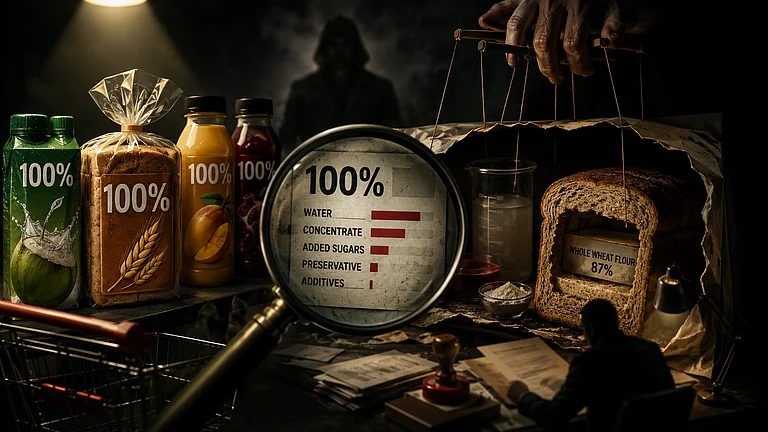
Are Food Companies Doing Enough?
While regulatory authorities can investigate misleading claims, the responsibility for substantiating advertising begins within the companies selling the products.
Khandelwal said food brands should not treat regulatory compliance as a final-stage approval after packaging and marketing strategies have already been developed.
“Product development and quality teams must establish the facts; marketing must ensure that the communication accurately reflects those facts; and legal and regulatory specialists must assess compliance,” she said.
She added that claims should be reviewed whenever formulations, suppliers, manufacturing processes or packaging change.
Aman J Jain, Co-Founder and CEO of dairy company Doodhvale Farms, said food manufacturers should examine not only whether a claim is factually accurate but also whether they can prove it and whether consumers are likely to understand it as intended.
“Too often, claims are written as marketing first and verified later, if at all. Words are chosen because they sound reassuring, and the evidence is expected to catch up,” he said.
Speaking from a manufacturer's perspective, Jain said companies should maintain supporting documentation, including supplier records, batch information and relevant laboratory reports.
He also pointed to the importance of periodic reviews, particularly when product specifications or sourcing arrangements change.
The challenge, according to the experts, is not simply whether a company possesses technical evidence supporting its intended meaning. It is also whether that meaning is communicated clearly enough to consumers.
Are ₹1 Lakh Penalties Enough?
The repeated penalties have raised another question: whether the financial consequences of misleading advertising are sufficient to discourage violations.
Under Section 21 of the Consumer Protection Act, 2019, the CCPA can direct advertisers to discontinue or modify misleading advertisements. It can also impose penalties of up to ₹10 lakh for a first contravention and up to ₹50 lakh for subsequent contraventions.
The penalties imposed in the Britannia, Sunrise, English Oven and Storia cases were ₹1 lakh each.
Khurana said such amounts may have limited deterrent value for large FMCG businesses, particularly when misleading advertising can generate commercial benefits.
He argued that penalties should be assessed against factors such as the scale of operations, duration of the violation and potential consumer impact.
The Sunrise order offers some indication of the commercial reach involved. According to figures recorded in the proceedings, the company sold 107,754 packets of the disputed bread in 2024-25, generating revenue of ₹38.11 lakh. Sales rose to 132,437 packets in 2025-26, generating ₹53.14 lakh.
These figures do not establish how much revenue was attributable specifically to the disputed advertising claim. However, they provide context for assessing the reach of the product and the size of the penalty.
Khandelwal said the effectiveness of regulatory fines also depends on the likelihood of detection and the consistency of enforcement.
Jain, meanwhile, argued that food companies must consider the reputational consequences of misleading consumers.
“For a brand like ours, the biggest penalty is not a fine. It is a lost customer,” he said.
Yet reputational pressure may not affect all manufacturers equally, particularly when consumers have limited information about product composition or little incentive to pursue complaints over inexpensive packaged goods.
Khurana pointed out that consumers can approach consumer commissions, regulatory authorities or the National Consumer Helpline, but the time and resources involved may discourage individual complaints.
He argued that stronger market surveillance and collective consumer redressal could help address misleading practices without relying primarily on individual consumers to identify violations.
Beyond '100%': Will Nutrition Warnings Help?
The debate over misleading ingredient claims comes at a time when FSSAI is also considering changes to how nutritional information is displayed on packaged foods.
In September, the regulator proposed a single-phase front-of-pack nutrition labelling framework involving prominent red warnings for products exceeding specified thresholds for nutrients of concern, including sugar, salt and saturated fat.
The proposal remains subject to finalisation and is not yet a mandatory nationwide warning system.
Unlike the CCPA cases involving disputed ingredient-composition claims, front-of-pack nutrition warnings are intended to help consumers identify products containing high levels of particular nutrients.
Agarwal said such warnings could make nutritional information easier to understand.
“A shopper should not need to calculate daily allowances in a supermarket aisle just to recognise that a product is high in sugar, salt or saturated fat,” he said.
However, he cautioned that recognising a warning does not necessarily mean consumers will change their purchasing decisions. Nutrition education, enforcement against misleading claims and access to affordable nutritious food would also be necessary.
Arora agreed that clearer labels could help consumers but questioned whether they would substantially change purchasing behaviour among households whose food choices are largely determined by price and availability.
“For most of the population, that choice does not exist. They buy what they can afford and what they find in the market,” he said.
He also argued that regulatory attention should extend beyond labelling to other food safety concerns, including microbiological contamination, heavy metals, pesticides and the authenticity of ingredients.
The recent CCPA penalties and proposed nutritional warnings therefore address different aspects of consumer protection. One concerns whether companies accurately represent what they sell; the other concerns whether shoppers can easily understand the nutritional characteristics of those products.
For food companies, both raise a common requirement: the information presented to consumers must be clear enough to support an informed purchase, rather than requiring shoppers to reconcile a prominent marketing promise with technical qualifications elsewhere on the packet.