Krishnamurthy leaves Flipkart after nearly a decade as CEO, with the business more than five times larger.
His tenure brought scale and market resilience, but profitability, quick commerce and the IPO remain unfinished.
The next CEO inherits a formidable e-commerce platform with a tougher task: turn scale into sustainable value.
Kalyan Krishnamurthy’s Flipkart Legacy: A Bigger Business, But Unfinished Ambitions
Kalyan Krishnamurthy leaves Flipkart with a much larger business and a strong market position, but profitability, quick commerce, employee liquidity and the long-awaited IPO remain unfinished parts of his tenure

AI Generated Image
Summary
Advertisement
Kalyan Krishnamurthy’s exit brings to a close nearly a decade at the helm of Flipkart. He took over as chief executive officer (CEO) in January 2017 and was elevated to group CEO in 2018. Under his leadership, Flipkart says its business grew more than fivefold. The company, however, has not disclosed the reason for his departure.
Flipkart has also maintained a strong position in India’s online retail market. Goldman Sachs Global Investment Research, citing Sensor Tower data, estimated that Flipkart and Myntra together accounted for 35% of India's monthly active user share in 2026 so far. Its analysis, drawing on Euromonitor data, also showed that Flipkart had maintained an approximately 10-percentage-point lead over Amazon in gross merchandise value (GMV) every year since 2019.
Shriram Subramanian, Founder and MD of InGovern Research Services, sees stabilising the business and protecting its competitive position as Krishnamurthy’s biggest strategic success. “I think Kalyan’s biggest strategic success was stabilising Flipkart, keeping it competitive and establishing it as probably the second-largest e-commerce player, while ensuring leadership in many categories continued,” he says.
Advertisement
Hit: Holding The Core Business Together
According to a PTI report citing Bernstein data, Flipkart’s monthly active user base grew 15% year on year in July 2026, while Amazon’s remained in negative territory over the period tracked by the research firm. The resilience is also visible in Flipkart’s festive performance. During the 2026 Big Billion Days, orders, units and buyers each grew 20-22% from the previous year, while about 60% of buyers came from Tier 2-plus cities.
The numbers suggest that Flipkart has managed to retain relevance even as India's online retail market has changed, with Meesho gaining ground in smaller cities and quick commerce changing consumer expectations around delivery.
Miss: Scale Has Not Yet Become Profitable
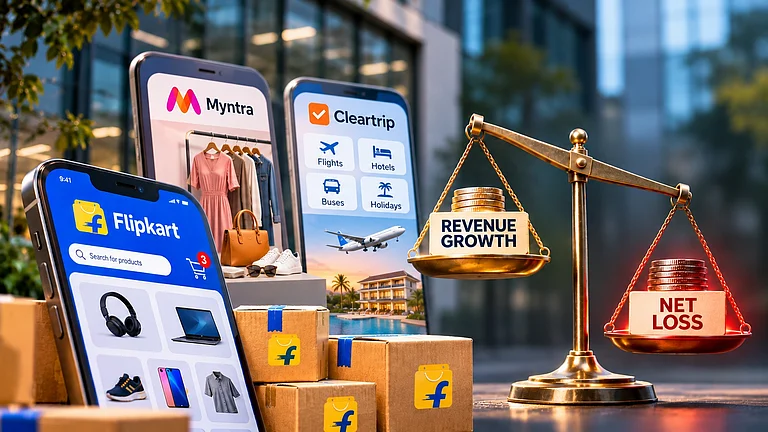
The core marketplace had been moving in the right direction through FY25. Flipkart Internet’s operating revenue rose from ₹14,846 crore in FY23 to ₹17,907 crore in FY24 and ₹20,493 crore in FY25, while net loss narrowed from ₹4,027 crore to ₹2,359 crore and then ₹1,494 crore, according to Tofler data.
Advertisement
FY26 brought a more uneven picture. After Flipkart’s redomiciliation to India, its consolidated financials brought multiple group businesses under Flipkart Internet. Revenue from operations rose 18% to ₹1,45,880 crore, while consolidated net loss narrowed only marginally to ₹8,468 crore from ₹8,646 crore. The marketplace entity reported operating revenue of ₹16,295 crore and a net loss of ₹5,498 crore. Flipkart has cautioned that the new consolidated structure makes year-on-year comparisons less straightforward.
For Subramanian, profitability remains one of Krishnamurthy’s biggest misses. “At this scale, they should aim for profitability,” he says. He also points to the need to increase average order value.
The pressure is important because profitability has become a condition for the company’s next phase. Moneycontrol reported in May that Walmart had asked Flipkart to defer its IPO plans and target EBITDA breakeven before the end of FY27.
Advertisement
Miss: The Quick-Commerce Catch-Up
Quick commerce is another strategic miss. Flipkart Minutes launched in August 2024, after Blinkit, Zepto and Swiggy Instamart had already established themselves. Flipkart has since expanded Minutes to more than 150 cities and said in September that it had nearly 1,200 micro-fulfilment centres and fourfold year-on-year growth.
But the gap remains. TechCrunch, citing people familiar with the business, reported in August that Minutes was handling 1.1-1.2 million orders a day, compared with about 1.4 million for Swiggy Instamart. Blinkit and Zepto remained the two largest quick-commerce players by order volume.
Subramanian argues that Flipkart was late to quick commerce and that Minutes is still lagging the leading players. That creates a difficult balancing act: Minutes needs investment to catch up, while the group is under pressure to improve profitability.
Unfinished Business: IPO, ESOPs And Leadership Churn
The IPO is the other major piece of unfinished business. Flipkart completed its reverse flip in March 2026, moving its domicile from Singapore to India, a structural step towards a domestic listing. But Walmart has yet to set a firm timeline.
Advertisement
The uncertainty has also created an employee-liquidity problem. Flipkart’s second ESOP liquidity event in July allowed eligible current employees to cash out up to 5% of vested options at ₹713.40 per option. Moneycontrol reported that the latest exercise valued Flipkart at about $38.2 billion, up from $36 billion at its May 2024 fundraise.
More than 1,000 former Flipkart employees subsequently appealed to Walmart’s board for parity with current employees in the event of a stock buyback, Moneycontrol reported. At least 14 VPs and SVPs have also left over the past year, according to the publication.
Subramanian sees ESOP liquidity as part of Krishnamurthy’s unfinished business. “If Walmart wants to do an IPO, I think the biggest miss for Kalyan was in terms of ensuring exit for ESOP holders who were expecting an IPO,” he says.
The company is also facing a governance issue. The publication reported in October that Walmart was investigating allegations of kickbacks exceeding ₹150 crore involving Flipkart employees in its smartphones and luggage and travel accessories divisions. Flipkart said it has robust governance processes and controls and is committed to integrity and compliance. The investigation remains ongoing.

What The Next CEO Inherits
The next CEO inherits a company with enormous scale and a strong core marketplace, but also a more demanding set of priorities. Subramanian says the new leader will have to defend market share, gain traction in quick commerce, launch new categories, increase B2B sales, improve profitability and address the delayed IPO. He also sees opportunities in B2B and B2C exports.
Krishnamurthy’s record is therefore neither a simple success nor a failure. He helped stabilise and scale Flipkart through a period of intense competition and strategic change. But the next phase will determine whether that scale can translate into sustainable profits, a stronger quick-commerce position and a credible path to public markets.