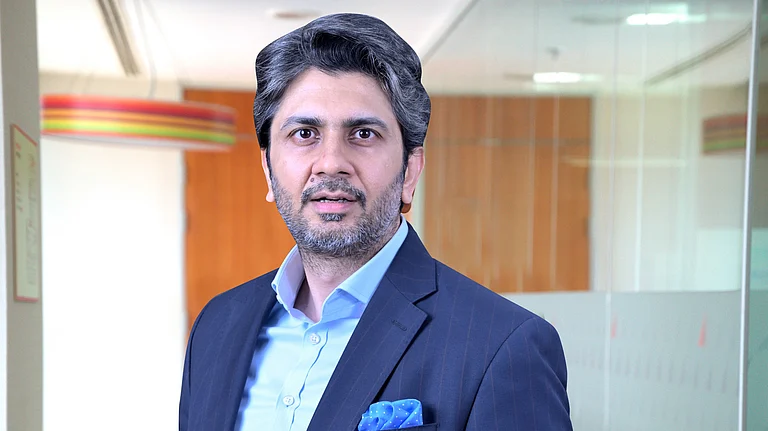
India’s wealthy promoter families are rethinking how capital is owned, managed and deployed, with rising interest in formal family offices, overseas diversification and alternative income-generating assets, said Alok Sanghi, former promoter of Sanghi Industries, which was acquired by Ambuja Cements in 2023. Now leading his family office - Resolute Corp Bharat, Sanghi believes promoter wealth is steadily shifting beyond single-business concentration towards a more institutional capital allocation model.
GIFT City Can Draw Family Office Capital If Policy Trust Builds: Alok Sanghi
Former Sanghi Industries promoter says Indian business families are increasingly moving from concentrated operating wealth to diversified, professionally managed portfolios

Gift City LinkedIn
Advertisement
In an interview with Outlook Business, he talked about how India’s GIFT City could emerge as a meaningful hub for family office capital if it builds long-term policy credibility, while also outlining his preference for Indian equities, gold, REITs, InvITs and selective global opportunities.
Edited Excerpts:
There is a sense that promoter families today are more willing to sell businesses to private equity or strategic buyers, and many attribute it to a generational shift in businesses.
I would describe it as evolution rather than a sudden shift. Earlier generations typically built new businesses by using cash flows from an existing company. Promoters incubated fresh ventures internally and retained control across multiple businesses.
Today, the opportunity set is wider, growth cycles are faster and new sectors often require significant capital. Many families are therefore asking whether capital tied up in mature businesses can generate better returns elsewhere.
That has made promoters more open to strategic sales or private equity transactions. Increasingly, the decision is being viewed through the lens of capital efficiency and future opportunity rather than legacy attachment alone.
Advertisement
Family offices in India are becoming more structured. What is driving that institutionalisation?
The first driver is complexity. Wealth management today goes far beyond deposits, land or a handful of listed stocks. Families are evaluating private markets, global assets, structured products, REITs, InvITs and alternatives, which requires professional expertise.
The second driver is the changing nature of families themselves. Different generations often have different priorities, risk appetite and levels of involvement in the core business. Wealth can no longer be managed informally by one or two individuals.
The third is concentration risk. Many promoter families still have a large portion of wealth linked to one operating company or sector. A family office helps diversify assets, create liquidity and build continuity across generations. Increasingly, family offices are becoming structured investment platforms rather than administrative extensions of the family.
Does that mean promoters are now becoming capital allocators rather than only operators?
Yes, that is one of the clearest transitions underway. Traditionally, promoters were known for building factories, scaling businesses and managing operations. Today, many of us must also think like portfolio managers for family wealth.
One role is running the operating company. The other is allocating capital across sectors, geographies and time horizons. Those are distinct disciplines. Families are increasingly recognising that wealth management needs institutional systems, reporting frameworks and governance structures, much like corporate India gradually moved towards professional management.
Advertisement
Why are Indian family offices increasingly looking beyond India?
Because diversification is becoming essential in a more uncertain world. Recent years have shown how quickly geopolitical shocks, wars, pandemics and policy moves can disrupt markets. Wealth concentrated in one geography carries one set of risks, however strong that market may appear.
The second reason is returns. Different countries move through different cycles. At certain points, overseas markets may offer more attractive valuations, stronger currencies or better relative opportunities. Indian investors are therefore becoming more global in mindset and seeking the same flexibility international investors have long used in portfolio allocation.
How attractive are hubs such as Dubai and Singapore for family offices?
They are attractive because they combine tax efficiency, ease of doing business and access to global markets. Taxation can be favourable, particularly for NRIs, but that is only one element. These jurisdictions also offer strong financial ecosystems with global banks, trust structures, legal expertise and cross-border execution capabilities.
Currency diversification is another factor. Holding part of family wealth in dollar-linked assets can help reduce the long-term impact of rupee depreciation. So the attraction is broader than tax alone. It is about access, efficiency and portfolio flexibility.
Advertisement
Can GIFT City realistically emerge as India’s answer to Singapore or Dubai?
It has the potential to become an important hub for India-linked capital. The objective of GIFT City is to create an international financial centre within India so that domestic wealth and India-focused pools of capital do not always need offshore structures. There are natural advantages. Costs can be lower, talent is available domestically and it offers direct proximity to the Indian market.
But financial centres are built over time through trust. Investors need confidence that tax rules, regulations and policy treatment will remain stable and predictable. Established centres such as Singapore benefit from decades of that credibility. If GIFT City can build the same reputation for consistency, it can attract family offices, funds and treasury operations in a meaningful way.
What is your broad market view amid geopolitical uncertainty?
Advertisement
The first issue is always the time horizon. A trader reacting to daily headlines and a family office investing for ten years are operating in completely different frameworks. From a long-term perspective, India remains a core structural story. If the economy expands significantly over the next decade, multiple sectors should benefit. Temporary volatility caused by wars, oil spikes or currency moves does not necessarily alter that long-term trajectory.
At the same time, family offices cannot ignore liquidity and cash-flow needs. That is why portfolios need more than growth equities. Alongside India exposure, families are increasingly looking at instruments that provide recurring income and some resilience during volatile phases.
So the response to uncertainty is not to retreat from markets, but to build more balanced portfolios across growth, income and diversification buckets.
You have advocated a meaningful allocation to gold. Why are you so bullish on that?
I see gold as a strategic portfolio asset rather than a short-term trade. My view is shaped by the global macro backdrop. Sovereign debt levels remain elevated, particularly in developed markets, while inflation risks have not fully disappeared. In such an environment, paper currencies can gradually lose purchasing power over time.
We have also seen a shift in trust after recent geopolitical conflicts, where reserve assets and payment systems became part of strategic disputes. That has encouraged many central banks to diversify holdings.
Gold benefits in such conditions because it is not tied to any one government or corporate balance sheet. It can function as an inflation hedge, a currency hedge and a crisis hedge simultaneously. For Indian investors, it also carries familiarity and liquidity. That is why I believe families should maintain a meaningful long-term allocation, around 10% of portfolios.
Why are REITs and InvITs gaining traction within family offices?
They reflect a broader financialisation of assets. Earlier, investors wanting exposure to property or infrastructure often had to buy physical assets directly. That meant large ticket sizes, illiquidity, maintenance burdens and concentrated bets.
REITs and InvITs allow investors to access commercial real estate, roads, transmission assets and other infrastructure through market instruments. In effect, they convert hard assets into investable financial products. For family offices, that can be particularly useful because these instruments can generate regular cash flows while reducing operational complexity. They can serve as an income layer within portfolios, sitting between low-yield deposits and higher-volatility growth assets.
That combination of yield, diversification and ease of ownership is why interest in these products is rising.