Economic Survey cautions domestic climate finance alone cannot meet India’s rising transition needs.
Adaptation, MSMEs, urban infrastructure and hard-to-abate sectors remain critically underfunded.
Stronger corporate transition planning seen as key to unlocking large-scale climate capital.
Economic Survey Flags Climate Finance Gaps as Companies Face Pressure to Act
Economic Survey warns domestic climate finance is insufficient, flags need for private capital

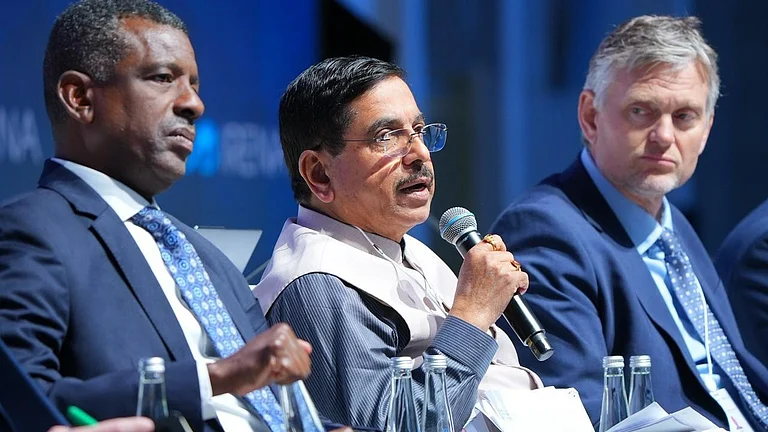
India’s climate transition and financing challenges Photo by Michał Robak
Summary
Advertisement
India faces global challenges in climate finance and relying solely on domestic resources will not be sufficient, the Economic Survey tabled in the Parliament on January 29 warned, urging greater mobilisation of private sector finance.
The survey further stated that critical areas, including adaptation, financing for micro, small and medium enterprises (MSMEs), urban infrastructure and hard-to-abate industries, remain underfunded. Currently, about 83% of India's finance for mitigation and 98% of finance for adaptation is sourced domestically.
"However, the gaps in available finance and the needs persist, relying solely on domestic resources will not be sufficient," the survey warned.
While India has reduced its emissions intensity by 36% since 2005 and achieved 50% non-fossil power capacity ahead of schedule, climate finance remains skewed towards mature sectors such as solar, wind energy and energy efficiency, the survey mentioned.
International public sector climate finance is, therefore, essential for mobilising private sector finance, required to meet climate ambitions at an affordable cost, particularly for emerging technologies and large-scale adaptation projects, where risk-mitigation and risk-sharing mechanisms are still underdeveloped, the survey stated.
Advertisement
Bridging Climate Finance Gap
India has already taken several steps to mobilise climate finance, including issuing sovereign green bonds to fund low-carbon public infrastructure, providing policy signalling and market benchmarks. In As well as, permitting 100% FDI for renewable energy projects, strengthening finance institutions, such as Indian Renewable Energy Development Agency Ltd (IREDA), National Bank for Agriculture and Rural Development (NABARD), Small Industries Development Bank of India (SIDBI), Power Finance Corporation Ltd (PFC) and Rural Electrification Corporation Ltd (REC).
In addition, Sebi's Business Responsibility and Sustainability Reporting (BRSR) framework, green bond guidelines and IFSCA's guidance on sustainability-linked lending have improved disclosure quality and investor confidence in climate-related investments.
The Reserve Bank of India has also introduced the green deposit framework that optimises the flow of credit to green activities/projects by channelising institutional and household savings, with guardrails in place to overcome greenwashing challenges.
Advertisement

Commenting on the need for finance in facilitating better cities, Arunabha Ghosh, CEO, Council on Energy, Environment and Water (CEEW), said, “By recognising the interconnected challenges of urban heat, water stress, waste management and climate-resilient infrastructure, and by urging alignment between infrastructure funding and city-level climate plans, the survey acknowledges that better cities require smarter institutions, finance, and behaviour change.”
She further added that the focus on circular water reuse as both an environmental necessity and an economic opportunity, alongside calls to strengthen municipal finance through instruments such as green bonds, underscores that better urban outcomes require smarter public investment and stronger local capacity.
According to a report by the Institute for Energy Economics and Financial Analysis (IEFFA), credible corporate climate transition planning is becoming crucial for mobilising capital, yet in India it remains fragmented and largely driven by compliance, even as the country requires cumulative investments of $10trn to achieve net-zero emissions by 2070.
Advertisement