Musk says US solar tariffs raise costs and slow renewable power deployment.
He argues solar energy could meet America’s entire electricity demand if barriers ease.
Rising AI and data centre demand makes affordable clean power increasingly critical.
Musk Slams US Solar Tariffs as Barrier to America's Power Needs at Davos — Here’s Why
At Davos, Elon Musk criticised US solar tariffs, warning they undermine America’s growing electricity needs

Elon Musk attends the Annual Meeting of the World Economic Forum in Davos, Switzerland on January 22 Photo by AP/Markus Schreiber
Summary
Advertisement
Elon Musk criticised US tariff barriers on solar energy, advocating for solar power to meet the US electricity needs, unlike Trump’s focus on oil on January 22, reported Reuters.
In addition, he announced aggressive targets for Tesla, including humanoid robot sales next year, as well as flagging European approval for self-driving tech within weeks.
After years of describing the World Economic Forum's annual meeting as “boring” confab of out-of-touch elites, the world's richest man was interviewed by World Economic Forum interim co-chair Larry Fink.
The BlackRock CEO expressed his admiration for Musk at the start of the wide-ranging discussion, which covered the future of robots and AI, the economic benefits of reusable rockets and Musk's childhood fascination with science fiction.
Due to his close relationship with US President Donald Trump and his management of companies like SpaceX, which owns Starlink, X, a social media platform, and xAI, an artificial intelligence start-up, Musk has grown in prominence in recent years.
Advertisement
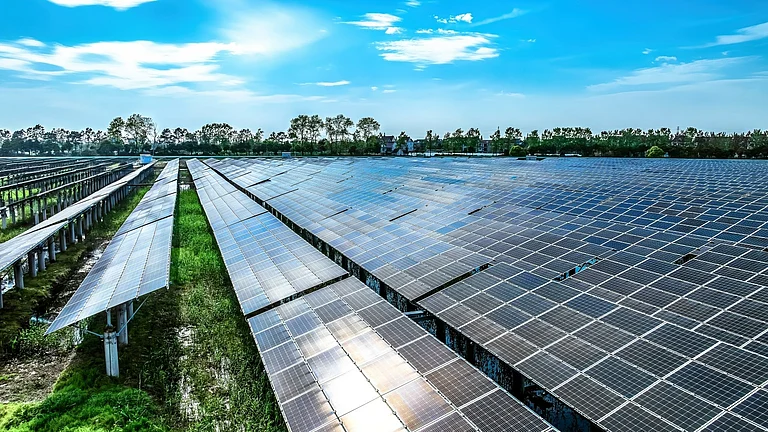
Musk broke with Trump on renewable energy, claiming that the US could generate enough solar energy to meet all of its electricity needs, including the soaring demand brought on by the growth of Big Tech's energy-hungry data centres.
"You could take a small corner of Utah, Nevada or New Mexico - a very small percentage of the area of the US - to generate all of the electricity that the US uses," he added.
"Unfortunately, the tariff barriers for solar are extremely high and that makes the economics of deploying solar artificially high," Musk said.
Trump has been vocal for encouraging oil majors to drill more for oil and gas while being critical of clean energy sources.
His freeze on approvals for major onshore wind and solar projects has left thousands of megawatts of capacity in limbo at a critical time for the US as it rushes to secure enough power to meet soaring AI-driven requirements.
Advertisement

Solar Cost Advantage Grows
Utility-scale solar power has become one of the cheapest sources of new electricity generation, with levelised costs significantly lower than many fossil-fuel alternatives, reflecting sharp declines in installation and technology costs over the past decade.
According to a July 2025 report published by the International Renewable Energy Agency (IRENA), in 2024, solar photovoltaics (PV) were, on average, 41% cheaper than the lowest-cost fossil fuel alternatives, while onshore wind projects were 53% cheaper. Onshore wind remained the most affordable source of new renewable electricity at $0.034/kWh, followed by solar PV at $0.043/kWh.
The addition of 582 gigawatts (GW) of renewable capacity in 2024 led to significant cost savings, avoiding fossil fuel use valued at about $57bn. Notably, 91% of new renewable power projects commissioned last year were more cost-effective than any new fossil fuel alternatives.
This cost advantage helps explain solar power’s rapid deployment despite shifting policy landscapes in the US and globally.
Advertisement