It is a breezy 240 km ride from Bengaluru to Kadur taluk in Chikmagalur district, Karnataka. The sun continues to play hide and seek among the monsoon clouds on a lazy Sunday afternoon. While the city folks are enjoying their afternoon siesta, the scene on this side of the state is quite different. The planting season has arrived and one can spot farmers hard at work on furrowed pieces of land. A few kilometers away as we enter the village, the scene changes. We are now welcomed by vast stretches of sturdy sunflower stems and further on bordered by fields decorated with plump pomegranate vines. The extensive spread of fruits and flowers make for a picturesque setting till we reach a huge plot of land covered by long strips of silver plastic sheets.
Planting Machines
Kamal Kisan seeks to ease the troubles of small farmers with its low cost and easy-to-use products

This is the only field here where the saplings have just been sown and the mulch layer is being rolled on with the help of a tractor. As the tractor chugs along a row of saplings, it unfolds a thin plastic film which is tightly pressed down by firm metal wheels and covered with soil by metal discs that ensure the film is in place. Mulching is a farm procedure adopted by fruit and vegetable farmers to preserve moisture and reduce weed growth. It is an important step in crop cultivation, often done manually requiring a lot of farm hands. But this 10-acre farm land that has jalapeno pepper saplings in its bed, is being tended to by only three labourers — one driving the tractor and the other two securing the plastic film wherever uneven. And farm owner, Vageesh Gowda, seems mighty impressed with the efficiency of his brand new purchase — the mulch layer device by Kamal Kisan. “Mulching is a time-consuming activity for which traditionally I would employ 10 labourers who would complete the process over 10 days. The entire exercise would cost me Rs.3,000 per day and given the labour shortage, it is cumbersome to find farm hands,” he explains.
On the lookout for mechanised solutions for his farm, Vageesh visited several farm fairs where he came across imported products that cost between Rs.80,000 to Rs.4 lakh. While these machines promised a higher crop yield, they weren’t suitable for Vageesh as the insecticide spraying procedure had to be replaced which he wasn’t too keen on. That’s when he came across Kamal Kisan’s mulch layer equipment that could be drawn by a tractor and cost only Rs.35,000. “Today, I am able to complete mulching for four acres in one day with only three labourers thanks to the machine. Apart from saving time and money, this is a portable device that Kamal Kisan can modify as per my requirement,” he says.
Like Vageesh, there are several farmers who can benefit from the adoption of technology and mechanisation in agriculture. Mechanisation is a key element that has improved crop productivity globally. As per a December 2015 report by FICCI titled Transforming Agriculture Through Mechanisation, the tractor accounts for a major part of mechanisation in farms till date. However, the penetration of other equipment remains negligible with only 40-45% of Indian farms being mechanised compared to 95% in the US, 80% in Russia, 48% in China and 75% in Brazil. The report outlines three key factors as obstacles to the adoption of mechanisation in farming: small and scattered land holdings, lack of after-sales support and unwillingness of banks to finance the purchase of such equipment. Set up in 2012 by electrical engineer Devi Murthy, it is this segment of farmers that Bengaluru-based Kamal Kisan seeks to cater by building farm equipments suitable for the needs and budgets of small farmers.
Sowing the seeds
Having worked as a product developer at her family business, Kamal Bells, an automotive parts maker, Murthy was eager to be a part of a business that let her interact with the end-user directly. “I knew that I wanted to something in the social sector but given my background in electrical engineering, I failed to see what I could do in the sector. I lacked that sense of direction then,” she recalls. A suggestion by a friend to consider developing farm equipments given her academic background led her to explore opportunities in the agricultural sector. Murthy admits that being a city girl, she had never visited a farm before. But once she was focused on developing products for the sector, she attended farmer fairs, travelled to fields across the country and surveyed farmers to understand their needs and the products already available in the market.
The budding entrepreneur often juggled her new interest in farm equipment with her day job as the business development head at her family firm. “I would sneak out two hours earlier than usual from my regular job and spend time at my workshop in the same facility. I had hired two people with my salary and together we would inspect existing farm equipment from China and tinker around to see how we can make it better and suitable for the Indian farmer,” she says. With a seed fund of Rs.5 lakh from the Rural Technology and Business Incubator (RTBI) at IIT Madras, Murthy began her experiment. Tamaswati Ghosh, CEO, RTBI talks about the incubator’s grant to Murthy, “We were very impressed with her passion and determination to make a difference in the lives of farmers. Kamal Kisan’s products are aimed at small and marginal farmers. Not only is the initial capital investment required from farmers less, compared to other products, but over a period, these products can help farmers save more from reduced labour cost.”
Murthy’s first product idea was a sugarcane harvester and she began building one, but several field visits and farmer inputs later, she shifted her focus to an unconventional rice transplanter. However that didn’t quite work out to her expectation. She was running out of money and had to take what she calls, a “difficult” decision to put both these products on the backburner and proceed with ones that could be taken to the market faster. So, Kamal Kisan first manufactured a vegetable planter in July 2015 and priced it at Rs.2,000 when the entry price was Rs.2,500. Being a low-cost product in an already existing category, the product has done well since its market launch in October 2015 and has improved the cash flow situation at the start-up. AB Chakravarthy, senior investment manager at social enterprise incubator, Villgro that assisted Murthy with seed funding says, “Entrepreneurship is a long journey and social entrepreneurship is an even more tedious one. With the hand planter, Kamal Kisan is purely playing on the cost aspect as it is a product very suitable for small farmers.”
There is enough evidence to corroborate this. Sachin Mane, a mechanical engineer by education and a two-wheeler dealer in Chikodi taluk in Karnataka’s Belagavi district, owns a six-acre land that has traditionally been used to cultivate sugarcane. Mane explains how in addition to being a water guzzling crop, the cash crop would suck most nutrients in the soil rendering it useless for other crops. So when he took over, he extensively surveyed farm lands in his state to change the crop cultivated on his field. That’s when he came across Kamal Kisan’s hand planter. Saplings once sown in a cartridge are dropped into a metal device which when expanded and contracted, drops the sapling into the designated spot and covers it up with soil. “It’s a very simple design and easy-to-use product. Also, the team is always available when I need them, the first planting season, an engineer stayed with us in the village till the work was complete,” says Mane. The farmer who now grows water melon, cauliflower and sweet corn on his field had traditionally employed 12-15 people for planting the sapling who covered only one acre a day, incurring a daily cost of Rs.3,000. But for the current planting season, he called for three labourers and together using the hand planter, they managed to complete an acre in just two hours.
Digging deeper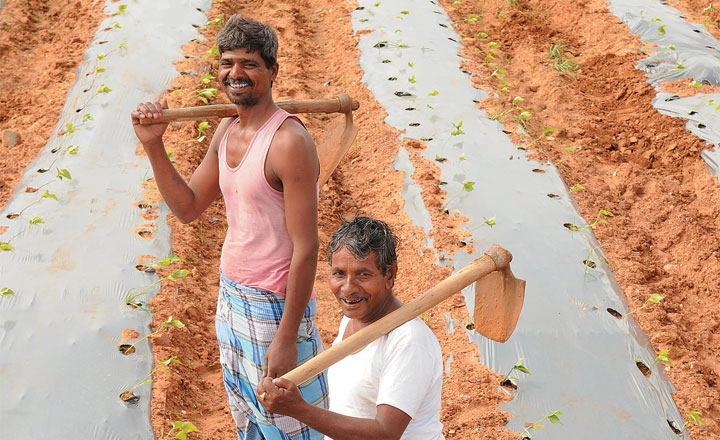 While the cost and time reduction clearly benefit small and marginal farmers, Murthy explains how the problem of acute labour shortage was far more dire. The FICCI report mentioned earlier cites decreasing farm labour as a critical issue of concern, estimating it to reduce to 26% of the labour force by 2050. Villgro’s Chakravarthy puts the issue in perspective, “The migration of labour from farm fields is something that has happened since 1991 with the opening up of the economy. Majority of the farm hands today are mostly people in their mid 40s and do not wish for their sons or daughters to continue this work, it is considered a social taboo. They’d prefer to employ them at a catering unit or as a security guard at an ATM in the city, but not as a farmer as that could ruin their chances of finding a good life partner.”
This explains Murthy’s focus on developing products that are easy to use and maintain for small and marginal farmers. She has sold her products to 300 farmers and clocked a revenue of Rs.6.5 lakh in FY16 and is targeting Rs.40 lakh for FY17. Much of that confidence is driven by her next product that is in the pilot stage — the sugarcane planter. Currently modeled at an estimated price of Rs.95,000, Murthy’s product is much cheaper than other similar products in the market that have some additional features but come with a price tag of Rs.1.25 lakh. Chakravarthy, too, is gung-ho about the new launch, “The sugarcane planter is a mass product. Just in the northern belt of Karnataka, there are 5 lakh – 10 lakh sugarcane farmers who can benefit from this product. Also, Devi’s model performs the three critical functions — opening up the soil, planting the crop and closing the shoot duct.”
Even as Murthy focuses her energies on perfecting the sugarcane planter and is working on a mini rice mill, she continues to deal with basic challenges in the sector. “Farmers are often apprehensive about adopting new technology given their experience with some previous product. Thus, convincing them is tough as they aren’t very open to conducting experiments on their field. Also, each farmer adopts a different way of farming and we need to build a product that can suit multiple needs,” she adds. Chakravarthy also reiterates this when he stresses, “Enterprises in this sector must not attempt to change farmer practices as that would lead to poor adoption of technology. Products must be designed keeping that in mind.” Armed with further funding of Rs.25 lakh under the RTBI’s seed support scheme for further expansion, Murthy is all set to incorporate suggestions and lessons learnt on the field. The 31-year-old who spends at least three days a week on the farm has identified crucial markets within her home state, Karnataka and is eyeing Tamil Nadu as a potential market given the prevalent high labour wages there.