The government escalates action against IndiGo after a week of mass cancellations and delays.
IndiGo’s operations collapsed after new FDTL rules, pushing cancellations above 1,000 a day.
A DGCA probe is underway, and experts say penalties could include heavy fines, flight restrictions or even slot suspensions.
Fines, Flight Cuts, Passengers' Class Action: What IndiGo Could Face After Its Operations Meltdown
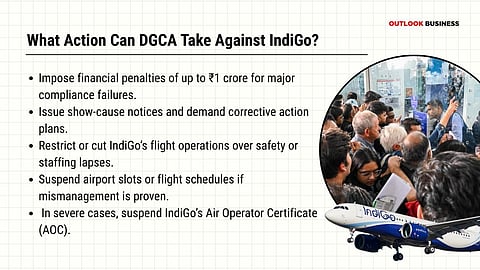
Legal experts say if found liable, IndiGo can face several punitive actions from DGCA. DGCA’s enforcement tools include licence cancellation, suspension and imprisonment up to two years, fines up to ₹1 crore for serious violations, restriction or curtailment of flight operations for safety or compliance lapses, or suspension of slots or schedules if it finds mismanagement

PTI
Summary
Advertisement
A week into IndiGo Airline's mass flight cancellations and delays, the government has stepped up its regulatory action against the carrier’s management. After sending a show-cause notice to IndiGo CEO Pieter Elbers, reports claim aviation regulator Directorate General of Civil Aviation (DGCA) is reportedly planning to reduce its flight capacity and reconstitute its board.
The actions come after IndiGo’s daily operations deteriorated sharply from late November, with cancellations rising from 170–200 per day to over 1,000 on December 2025. Earlier, the airline blamed this on several converging factors including minor technology glitches, adverse winter weather, heavy airport congestion and underestimation of crew requirements after Phase-2 of the Flight Duty Time Limitations (FDTL) rules took effect.
Later, reports confirmed that FDTL rules were the key factor which deteriorated IndiGo's on-time performance (OTP) to just 3.7% on December 5. It had over 80% OTP at most Indian metro-city airports in October 2025.
Advertisement
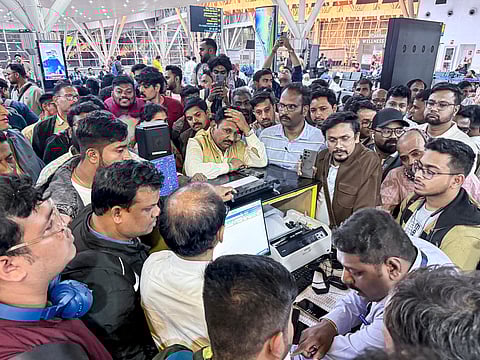
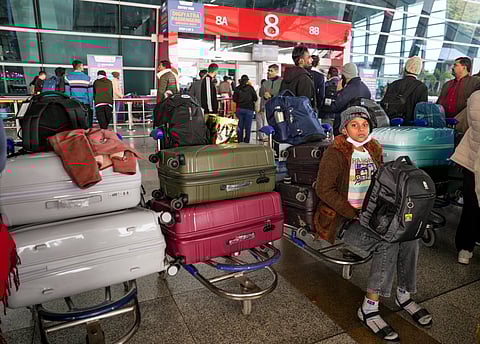
This operations disruption led to wide-scale problems across India, with images of distressed passengers coming from across the country. Passengers were seen in heated verbal spats with IndiGo staff at the ticket counters across Delhi, Mumbai, Ahmedabad, Bengaluru and elsewhere.
PTI
Amid the chaos, the government intervened, first rolling back FDTL rules implemented on November 1 and the Ministry of Civil Aviation set up a 24×7 control room to oversee flight operations, airport conditions, and passenger-support requirements.
It also took setup a four-member committee to review the circumstances leading to the massive operational disruptions. The panel includes Sanjay K. Bramhane (Joint Director General), Amit Gupta (Deputy Director General), Capt. Kapil Manglik (SFOI), and Capt. Lokesh Rampal (FOI).
The enquiry will identify causes of disruption, assess manpower planning and rostering under the revised FDTL CAR 2024, review compliance gaps, determine accountability for planning failures, evaluate mitigation measures and monitor restoration steps. Findings will be submitted to DGCA within 15 days.
Advertisement
Legal experts say if found liable, IndiGo can face several punitive actions from DGCA. DGCA’s enforcement tools include licence cancellation, suspension and imprisonment up to two years, fines up to ₹1 crore for serious violations, restriction or curtailment of flight operations for safety or compliance lapses, or suspension of slots or schedules if it finds mismanagement.
"In extreme cases, suspension of Air Operator Certificate (AOC), though this is very rare and used only when safety is compromised," said Yatharth Rohila, Partner, Aeddhaas Legal LLP.
If it is established that the airline deliberately delayed the roster rollout, the DGCA will be well within its powers to initiate show-cause proceedings, levy significant penalties, and impose operational restrictions, according to Partner, Co-Head of PE & VC Practice, Kochhar & Co.

Govt’s Action Against IndiGo So Far
DGCA has already issued a show-cause notice to IndiGo CEO, with Elbers asking for more time to reply on December 7.
Advertisement
"DGCA can also suspend personnel, e.g., Air India’s Director of Training was suspended for six months and may detain aircraft under Section 17(1)(b) of the Aircraft Act. IndiGo has been directed to submit an action plan covering recruitment, training, roster redesign, and safety-risk analysis. A formal inquiry committee will determine whether maximum sanctions apply," Raheel Patel, Partner at Gandhi Law Associates said.
According to reports citing government officials, IndiGo could be directed to reduce 300 flights per day for the winter schedule. The airline claims to operate over 2,300 daily flights, of which about 2,200 are on domestic routes. Another report has claimed that the government might ask the airline to reconstitute its board to include individuals who have deep technical and operational experience and background in the aviation industry.
However, experts say MoCA tends not to run parallel enforcement tracks, because the regulator (DGCA) is the statutory authority.
"But the Ministry can, and often does, intervene at the policy level by demanding compliance reports, convening emergency meetings, ordering DGCA to examine whether consumer-protection obligations have been breached, and publicly directing airlines to restore normalcy," said Patel.
Advertisement
Many pilots' union bodies have alleged that disruptions were “artificially created” to pressure the ministry and DGCA from implementing FDTL rules.
What Caused IndiGo Operations Meltdown?
The FDTL rules were aimed to determine how long a pilot can be on duty, how much rest they must get, and how many late-night or early-morning flights they can operate. These limits sit inside DGCA’s Civil Aviation Requirement framework and are based on global standards, recognising that fatigue is a major risk factor in aviation safety.
The key changes expand the definition of night to 00:00–06:00, increase weekly rest from 36 to 48 hours (and up to 60 hours after multiple night duties), and sharply reduce night workload by limiting duties touching the night window to just two landings. Night flight time and duty periods have also been shortened, and caps on consecutive night shifts have been tightened.
Airlines must now reach cumulative duty limits more cautiously and file regular fatigue reports as DGCA pushes them towards a full Fatigue Risk Management System.
The regulator tightened the framework for three reasons: evidence that long, busy night schedules were driving fatigue; years of pilot-union pressure, including petitions before the Delhi High Court; and the stress created by India’s rapid aviation growth and high aircraft utilisation.
India last revamped its FDTL norms in 2019. The latest rules were first introduced in 2024 and expected to come into effect in June that year; however, due to pushback from airlines, DGCA deferred the rollout. Later, the pilot unions reached out to the Delhi High Court demanding the implementation of the new norms. Following the High Court order, DGCA asked for the tentative date for the new regulations’ implementation from airlines.
DGCA began implementing the revised FDTL norms in two phases, with Phase 1 starting on July 1 this year, when 15 of the 22 clauses came into effect, including longer mandatory rest periods such as increased weekly off time. Phase 2 followed on November 1, 2025, bringing in the remaining seven clauses that imposed stricter limits on night duties, caps on night flights and landings, and tighter duty-period restrictions.
Within days of the full rollout in early November, airlines, particularly IndiGo, began reporting widespread delays and cancellations as their schedules came under pressure from the more stringent duty-time requirements.
Just a month into the new norms kicking in, IndiGo started showing signs of stress in its operation. According to reports, the airline cancelled 1,232 flights in November 2025. Of these, 755 cancellations were attributed to crew shortages and constraints, another 258 flights were cancelled due to airspace or airport restrictions, 92 because of air-traffic control (ATC) failures, and 127 for other operational reasons. In the first seven days of December, things worsened.
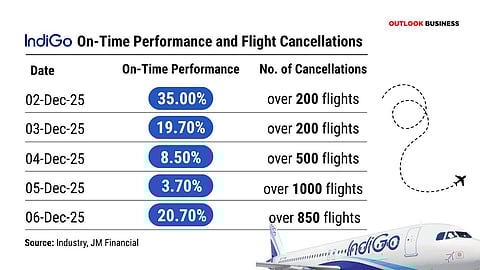
According to an analysis by JM Financial, the airline scrapped close to 200 flights on December 2, at least 200 on December 3, over 500 on December 4, more than 1,000 on December 5, its worst day, and around 850 flights on December 6. Between December 2 and 6, 2025, IndiGo’s operations deteriorated sharply, with on-time performance plunging from 35% to as low as 3.7%, and daily cancellations escalating rapidly.
Allegations of Manipulation
Airline Pilots' Association of India (ALPA India) later alleged that disruptions were “artificially created” and said that “whenever rules are promulgated that are not in favour of the airline, they, like spoilt children, delay flights… to put pressure on the ministry and DGCA”.
In a statement, pilots’ union President Sam Thomas claimed that in a November 24, 2025 stakeholder meeting, all parties agreed that no dispensation or exemption should be granted and emphasised that FDTL norms “exist solely to safeguard human life”.
Despite nearly two years to prepare for phased implementation, IndiGo’s winter 2025 roster expansion led to disruptions just 35 days after Phase II rollout. ALPA questioned why the crisis surfaced despite long notice and suggested it may have been engineered to pressure the government “for commercial gain”.
It sought an investigation into the alleged artificial pilot-shortage narrative, punitive action against IndiGo management, and full enforcement of FDTL norms.
The Federation of Indian Pilots similarly alleged that IndiGo imposed a hiring freeze and a “pilot pay freeze through cartel-like behaviour”, asserting the chaos is a “direct consequence” of cost cuts. Reports show IndiGo added about 15,014 weekly domestic departures for winter 2025–26 but inadequately recruited or planned rosters.
By the end of March 2025, IndiGo had 5,463 pilots. In a recent submission to DGCA, the carrier claimed that for its Airbus fleet, captain availability in December is 2,357 and first-officer strength is 2,194. This is lower than November’s 2,422 fleet captains and 2,153 first officers.
What IndiGo Might Face
If DGCA’s inquiry confirms deliberate manipulation, consequences may exceed routine penalties, as such conduct reflects intentional pressure tactics undermining safety oversight, said B. Shravanth Shanker, Advocate-on-Record, Supreme Court of India.
"DGCA’s enforcement tools include licence cancellation or suspension and, under the Aircraft Act’s proposed amendments, imprisonment up to two years or fines up to ₹1 crore for serious violations. Though DGCA does not formally impose statutory fines, it routinely levies penalties through its regulatory powers," he added.
Patel also agrees. He said that DGCA can impose financial penalties on the airline and on “accountable executives,” suspend or cancel approvals (including Air Operator Permit sub-permissions), initiate enforcement proceedings for violation of flight-duty limitations, order special audits, and in extreme cases direct a temporary reduction in flights until compliance is demonstrated.
"It also has the power to ground aircraft for safety-related manpower issues if crew availability is compromised by non-compliant rostering," he said.
PTI
Passengers Mull Class Action
Meanwhile, a LocalCircles survey of more than 30,000 IndiGo passengers found that 87% want the airline’s service deficiencies to be taken up under the Class Action provision of the Consumer Protection Act, 2019, a mechanism that allows groups of consumers with a shared grievance to collectively seek legal remedy. The poll was triggered by IndiGo’s mass flight cancellations over four days, which left thousands stranded and sent airfares soaring.
The group noted that class-action cases against airlines over refunds, cancellations and compensation are common globally, though still rare in India.
According to Shravanth Shanker, large-scale cancellations may also allow class-action complaints.
But before that, they can file complaints on the DGCA Air Sewa portal. DGCA regulates refund timelines and passenger rights, while the Consumer Protection Act, 2019 allows passengers to file complaints for service deficiency.
"Consumer courts frequently award ₹25,000–₹1,00,000 for distress, e.g., Delhi’s award of ₹50,000 for a 6-hour delay without updates and Mumbai’s ₹55,000 award for inadequate facilities during a 14-hour delay," he added.
According to Yatharth Rohila, Partner, Aeddhaas Legal LLP, under DGCA’s Civil Aviation Requirement (CAR), Section 3, Series M, Part II, passengers are entitled to free refund or re-booking on another flight if cancellation is informed at least 2 weeks in advance.
"If informed between 24 hours and 2 weeks, the airline must offer an alternative flight within 2 hours of the original departure or refund. If informed less than 24 hours before departure, passengers are entitled to compensation up to ₹10,000, depending on block time and fare paid, in addition to refund or alternate flight. Compensation applies only when the cancellation is within the airline’s control," he added.