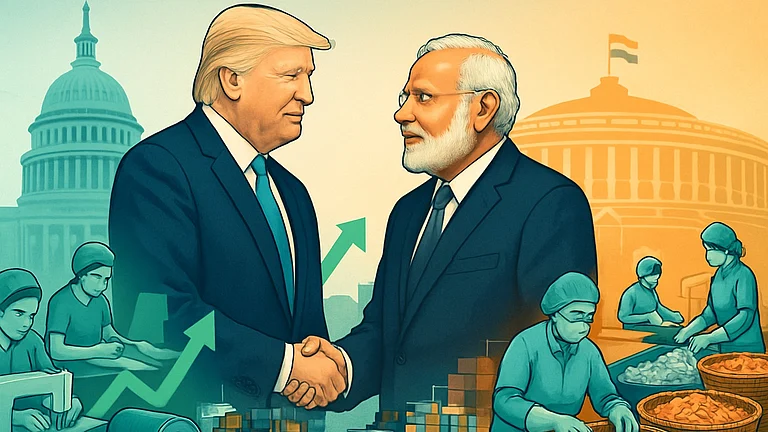
US cuts reciprocal tariffs on India to 18% from 50%, claims India agreed to stop buying Russian crude.
Finance Minister Sitharaman says the move augurs well for Indian exporters.
Exporters expected to expand into new and existing markets.
Sitharaman Says 18% Tariff Rate Is a ‘Good Augury’ for Indian Exporters
Finance Minister Nirmala Sitharaman said the reduction of US tariffs on India to 18% is a positive signal for exporters and could help boost outbound shipments

Union Finance Minister Nirmala Sitharaman
Summary
Advertisement
US President Donald Trump late on Monday announced the India–US trade deal and a reduction in reciprocal tariffs on India to 18% from 50%. Responding to the announcement, Union Minister of Finance Nirmala Sitharaman said on Tuesday that the decision to lower tariffs to 18% augurs well for Indian exporters.
“So, actually our exports will pick up now—that is my expectation—along with having found new markets where they will continue to operate,” Sitharaman told PTI. “It is a good augury for them (exporters).”
In a post on Truth Social, Trump stated that New Delhi has agreed to stop oil purchases from Russia and would begin buying from the US and potentially Venezuela. However, this has raised concerns over a reshuffling of India’s import basket and the risk of imported inflation in the absence of discounted Russian crude.
Russia has been offering crude at discounted prices since 2022, and India emerged as the second-largest buyer of Russian crude thereafter. This drew severe backlash from the US and other Western allies, who alleged that Indian purchases were fuelling the ongoing war in Ukraine.
Advertisement
In August, Washington imposed an additional punitive tariff of 25%, which took total tariffs to 50%, among the highest duties faced by any Asian economy. With the reduction in tariffs, India is now better positioned than regional competitors, including Vietnam, which faces a 20% tariff.
In a press conference on Tuesday, Union Minister of Commerce and Industry Piyush Goyal said the trade deal will “open massive opportunities for micro, small and medium enterprises (MSMEs), the marine industry, including seafood and shrimp exports, and the services sector.” Goyal also highlighted that sensitive sectors such as agriculture and dairy continue to remain protected in order to safeguard farmers’ interests, which are often cited as a matter of national interest.