Netanyahu has proposed a six-nation “Hexagon of Alliances” focused on security, diplomacy, and economic coordination in West Asia.
The bloc is expected to carry a stronger security dimension than IMEC, with countering Iran as a central objective.
India’s inclusion could enhance its regional influence — but may require balancing ties with Tehran and preserving strategic autonomy.
Israel's Hexagon of Alliances — Can India Be at the Core? | Explained
Israeli Prime Minister Benjamin Netanyahu has proposed a six-nation “Hexagon of Alliances” in and around West Asia, positioning India as a potential pillar

Israeli PM Benjamin Netanyahu
Summary
Advertisement
Ahead of Prime Minister Narendra Modi’s two-day visit to Israel, all eyes are on a new geopolitical concept, the Hexagon of Alliances, put forth by Israeli Prime Minister Benjamin Netanyahu. The proposed alliance is a six-member state strategic framework designed to collaborate in and around the West Asian region, prioritising security, diplomacy, and economic cooperation. New Delhi has been named as a potential pillar of this emerging bloc.
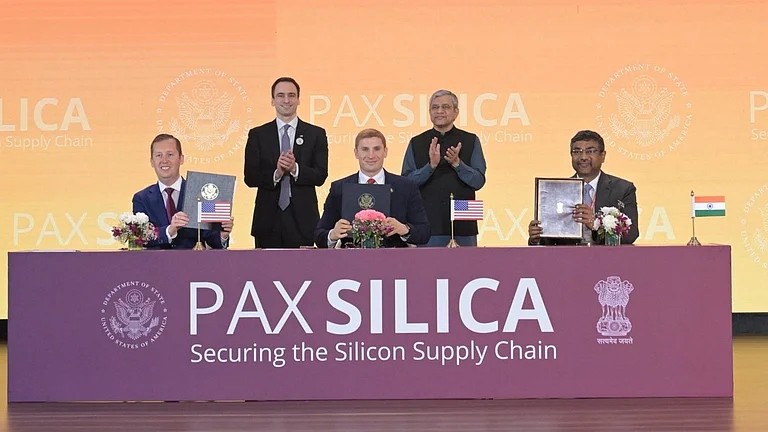
The announcement comes just days after India joined Pax Silica, a global tech alliance aimed at strengthening technological sovereignty, securing tech supply chains, and building resilient digital infrastructure for the next phase of digital industrialisation. The timing of these developments has raised questions about India’s evolving geopolitical positioning and its expanding footprint across strategic multilateral frameworks.
What Is the Hexagon of Alliances?
Netanyahu describes the India-Israel relationship as a powerful alliance between two global leaders. According to him, the Hexagon of Alliances would consist of six countries in and around West Asia, although the full list of member states has not yet been disclosed. However, he explicitly named India, Greece, and Cyprus as potential members, alongside other Arab, African, and Asian countries.
Advertisement
“In the vision I see before me, we will create an entire system, essentially a ‘hexagon’ of alliances around or within West Asia,” The Times of Israel cited Netanyahu as saying. “The intention here is to create an axis of nations that see eye to eye on the reality, challenges, and goals against the radical axes, both the radical Shia axis, which we have struck very hard, and the emerging radical Sunni axis.”
The language indicates a broader strategic alignment aimed at countering what Israel perceives as destabilising forces in the region, while also deepening structured cooperation among like-minded states.

What Are the Objectives of the Alliance?
The framework is expected to establish multi-track collaboration across economic, diplomatic, security, and defence sectors. Netanyahu reportedly drew parallels between the proposed bloc and the India-Middle East-Europe Economic Corridor (IMEC). However, according to Israeli officials quoted in reports, the Hexagon of Alliances is expected to have a far-reaching and significantly stronger security dimension than IMEC.
Advertisement
While IMEC primarily focuses on connectivity and trade corridors linking India, the Middle East, and Europe, the hexagon appears to be conceptualised as a broader diplomatic and strategic architecture, incorporating defence coordination and geopolitical alignment alongside economic cooperation.
Tackling Iran
At the heart of the proposed alliance lies the objective of countering Iran and other regional armed groups collectively known as the “Axis of Resistance.” This grouping includes Hezbollah, the Houthis, and Iranian-backed militias operating across Iraq and Syria. Netanyahu envisions the hexagon as a long-term diplomatic and security architecture aimed at limiting Iran’s influence across the region.
To put this into context, Iran and Israel have had no diplomatic relations since 1979. The United States has been deploying its largest military build-up in the region since 2003 and has urged Tehran to transfer 440 kg of near-weapons-grade uranium and agree to a nuclear deal. Israel has also demanded the physical removal of all enriched nuclear material from Iranian soil.
Advertisement
Israel and the United States are currently balancing their support for political developments within Iran while also calling for what has been described as a “complete regime change,” including the potential overthrow of Iranian Supremo Ayatollah Ali Khamenei. The proposed hexagon framework, therefore, appears to align with a broader Western and Israeli strategic posture toward Iran.
Why Is India Crucial?
According to reports, India’s inclusion is considered critical to the credibility of the proposed Hexagon of Alliances. New Delhi’s strategic location, alongside its deep-rooted ties with West Asia, economic scale, and technological capabilities, positions it as a valuable member.
Its diplomatic outreach to Europe and the Indo-Pacific is also seen as a strategic advantage that could expand the alliance’s global reach.
Beyond trade, Prime Minister Modi’s upcoming visit is expected to focus on deepening cooperation in defence, technology, agriculture, artificial intelligence, and water management.
India’s growing defence cooperation with Israel and expanding technology partnerships further reinforce its potential role within such a framework.
Advertisement
Strategic Balance
Just as joining Pax Silica comes with several trade-offs, New Delhi’s potential ascent to the Hexagon of Alliances would require a closely calibrated approach. India maintains close ties with Iran, particularly given Tehran’s significance in the development and operation of the Chabahar port.
For India, the alliance presents opportunities that come with costs. Deeper access to technology, stronger defence ties, and enhanced positioning as a rising global power are potential benefits. However, it also raises questions about managing strategic autonomy and mitigating potential risks to India-Iran bilateral ties.
As geopolitical alignments grow increasingly complex, New Delhi’s balancing act between strategic partnerships and regional sensitivities will remain central to its foreign policy calculus.