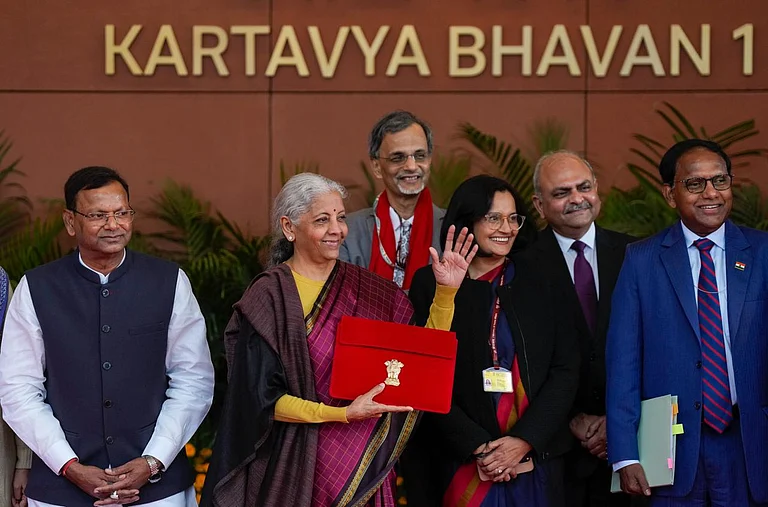
Finance Minister Nirmala Sitharaman is set to present her ninth Union Budget in February.
The Centre is working to narrow the fiscal deficit to 4.4% of GDP, down from 4.8% last year.
India’s fiscal deficit reached ₹8.25 lakh crore during April–October, amounting to 52.6% of the full-year target.
Budget 2026: What Fiscal Deficit Tells Us About the Government’s Finances?
Understanding India’s Fiscal Deficit Ahead of the 2026–27 Union Budget

Finance Minister Nirmala Sitharaman
Summary
Advertisement
As Union Finance Minister Nirmala Sitharaman prepares to present her ninth Union Budget this February, the Modi government is signalling that fiscal consolidation will remain its core economic strategy. The Centre aims to further shrink the fiscal gap without slowing the economy’s momentum.
India’s fiscal deficit touched ₹8.25 lakh crore in April–October, or 52.6% of the annual target, a sharper drawdown than the 46.5% recorded a year ago. The Centre is aiming to cut the deficit to 4.4% of GDP this year from 4.8%.
Subsidy outgo on food, fertiliser and petroleum reached to ₹2.46 lakh crore in the first seven months, consuming 64% of the revised allocation, almost identical to last year’s trend.
The government data shows receipts at ₹18 lakh crore and expenditure at ₹26.25 lakh crore for April–October, roughly 52% of the annual goals on both counts. A year earlier, receipts were tracking faster at 53.7% of the target, while spending was slightly lower at 51.3%.
Advertisement
These numbers raise a basic but important question: what exactly is the fiscal deficit, and why is it central to every Union Budget?
What is Fiscal Deficit?
In simple terms, a fiscal deficit comes up when the government’s expenses exceed its income. The earns most of its money from taxes, while its spending is used for salaries, subsidies, infrastructure and welfare programs.
When government spending outpaces what it earns, the administration has no choice but to borrow, either from domestic markets or overseas lenders. These borrowings steadily add to India’s total debt, which is why the fiscal deficit becomes a closely watched number every budget season.
The deficit is usually shown as a percentage of Gross Domestic Product (GDP). For instance, if India spends ₹1,00,000 crore and earns ₹90,000 crore, the shortfall of ₹10,000 crore can also be viewed as a share of the economy. This helps people gauge whether government finances are comfortably placed or under stress.
Advertisement
Factors Affecting Fiscal Deficit
Several factors can influence the fiscal deficit. Slow growth or rising unemployment can push the government to increase spending in order to support the economy.
Policy decisions such as starting new infrastructure projects or launching welfare schemes without raising enough tax revenue can also widen the fiscal deficit. Global factors, including inflation and changes in trade, add more pressure and influence how much the government eventually needs to borrow.
Fiscal policy, which is how the government manages taxes and spending, has a direct effect on the fiscal deficit. When spending goes up or taxes are lowered, the deficit usually grows because the government is putting out more money than it earns.
Keeping the fiscal deficit in check is important for a stable economy. If it stays high for a long time, it can push up prices, reduce investment and lower confidence in the markets. That is why the government monitors its earnings and spending closely each year.
Advertisement

As the 2026–27 Union Budget approaches, the fiscal deficit is one of the key numbers to watch. It gives an idea of how the government plans to manage finances, how much borrowing may be needed, and what steps it might take to support growth and keep the economy stable.