Government is in active discussions with the Finance Ministry to craft new schemes aimed at enabling large-scale polysilicon manufacturing—seen as the most critical missing link in India’s solar supply chain.
MNRE is aiming for 200 GW module and 100 GW cell manufacturing capacity by 2030, with a renewed push to build domestic capability in wafers and polysilicon.
PLI outlay of nearly ₹28,000 crore and measures like ALMM and prudent customs duties are being used to protect domestic industry from cheap imports and dumping.
India’s reliance on HVDC systems dominated by two global players—Hitachi and Siemens—poses risks. MNRE stresses urgent development of domestic high-voltage transmission manufacturing.
Talks Underway With Finance Ministry to Enable Large-Scale Polysilicon Manufacturing: MNRE Secy
The MNRE Secretary highlighted that India’s renewable energy expansion cannot rely on imported upstream components

MNRE Secretary
Summary
Advertisement
MNRE Secretary Santosh Sarangi on Saturday said that the government is working closely with the Finance Ministry to frame new incentive schemes aimed at scaling up polysilicon manufacturing in the country.
Speaking at the Global Energy Leaders Summit 2025, Sarangi said,“We are now looking at about 200 GW of module manufacturing and nearly 100 GW of cell manufacturing by 2030. We are also pushing for wafer and polysilicon manufacturing in a big way,” he said, emphasising that discussions with the Finance Ministry are underway to design targeted support for ramping up polysilicon production.
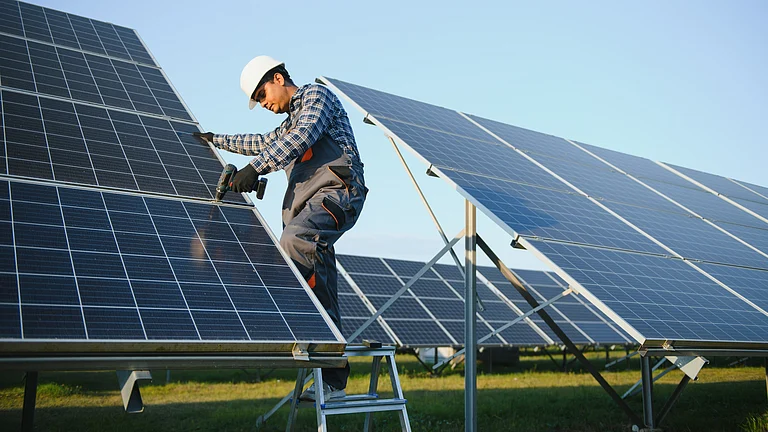
Sarangi underscored that India’s renewable energy expansion cannot rely on imported upstream components.“We want the entire manufacturing ecosystem to develop domestically, and polysilicon is the most crucial missing piece.”
He added that on the deployment front, the government is broadening its strategy to ease land constraints by encouraging floating solar and agrivoltaic projects. “Land will no longer be a limiting factor for renewable expansion,” he noted.
Advertisement
The MNRE Secretary highlighted that India already has strong policy support for manufacturing: the Production-Linked Incentive (PLI) scheme includes ₹24,000 crore for solar manufacturing and another ₹3,000 crore for green hydrogen, taking the total outlay for domestic industry to nearly ₹28,000 crore.
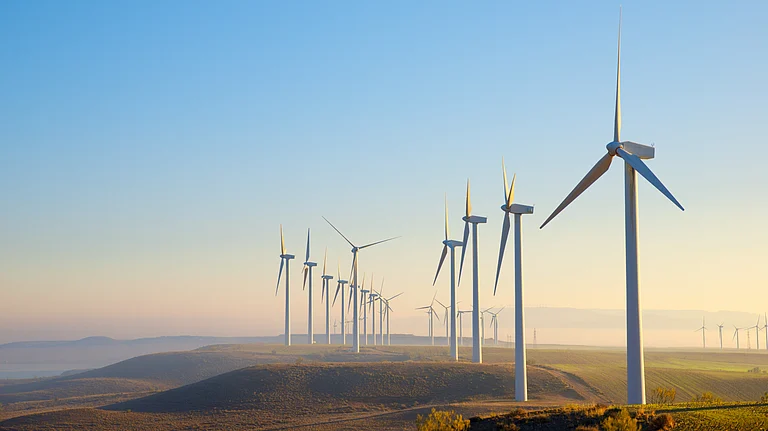
He also pointed out that the government has used customs duties prudently and introduced mechanisms like the Approved List of Models and Manufacturers to support domestic industry.
Calling transmission a biggest bottleneck the secretary said that, “Long-distance transmission depends heavily on HVDC systems, and currently only two global suppliers—Hitachi and Siemens dominate this space. This duopoly leaves us vulnerable.”
He also stressed that India must urgently develop domestic capabilities in high-voltage transmission technologies to ensure the grid can support massive renewable additions: “We have to push domestic manufacturing in a big way.”