For centuries, the Ganga has flowed through India’s hills, plains and Faith. Now, it flows through one of the nation’s most ambitious and well-planned efforts to heal the environment.
The Mystic River
The Namami Gange Mission helps protect the Ganga and encourages urban growth in ways that respect the river

Advertisement
The Namami Gange Mission was created to rejuvenate a river that flows for over 2,500 kilometres and sustains nearly half of India’s population. More than a clean-up drive, it is an effort that brings together government, researchers, local authorities and communities. For the future of many towns and cities is inseparable from the future of the river that sustains them.
How the Mission flows
Rejuvenating a river as vast as the Ganga calls for a well-oiled system. The Ministry of Jal Shakti tops the tier, providing policy direction and guidance. It ensures that the mission prioritises water management, sanitation and environmental protection.
The NMCG is the central body responsible for planning, funding, coordinating and monitoring all efforts to cleanse the river. It oversees the projects and tracks the river’s health.
The work then moves closer to the river through the State Programme Management Groups (SPMGs) that operate in Ganga basin states like Uttarakhand, Uttar Pradesh, Bihar and West Bengal. They work with urban local bodies, agencies and contractors for projects that address the specific needs of cities and towns.
Advertisement
At the grassroots of this endeavour are the District Ganga Committees. Chaired by the District Magistrate, these monitor drains, sewage and waste management and ensure the proper use of assets. They strengthen the people’s connection with river rejuvenation through regular 4M meetings (Monthly, Mandated, Minuted and Monitored).
The Wildlife Institute of India and international collaborators support the mission. They conduct biodiversity assessments, the Ganga River Dolphin Action Plan, and water-quality monitoring across more than 3,000 locations.
The Ganga Knowledge Centre
The Ganga Knowledge Centre (GKC) was established to create a knowledge base, analyse data and enable research. It works with national and international universities, institutions and NGOs to fill gaps in river science and policy.
The 67th Executive Committee of NMCG also approved several research projects.These include glacier monitoring of the Himalayan headstreams and development of a Digital Twin and Water Cycle Atlas for the Ganga Basin. Along with high-resolution SONAR riverbed surveys, it manages aquifer recharge studies over paleochannels.
Advertisement
PRAYAG (Platform for Real-time Analysis of Yamuna, Ganga and their Tributaries) is an online dashboard set up in 2023 to monitor water quality, project progress and performance of the sewage and common effluent treatment plants. Making this information visible and accessible, PRAYAG helps take informed decisions and promotes transparency.
The Pillars Of A Living River
The NMCG rests on six connected pillars, each looking after a crucial facet of the river’s health. One of the main components of this effort is sewage treatment infrastructure. By January 2025, the Mission had launched 206 projects. Of these,127 are operational and create a treatment capacity of 3,446 MLD — a 30-fold increase over pre-2014 levels.
Biodiversity conservation recognises the Ganga as a living ecosystem. The Gangetic Dolphin population has grown from 3,330 in 2018 to 3,936 in 2024, while over 1.43 crore Indian Major Carp fingerlings have been released to revitalise aquatic life and support local fishermen. Along its urban areas, riverfront development and surface cleaning have transformed the river’s facade. There have been 307 projects to modernise ghats and crematoria, while surface cleaning keeps the water accessible and safe for communities.
Advertisement
Afforestation and public awareness work hand in hand. Around 33,024 hectares of riverbanks have been planted. The Ganga Quest campaign has turned the mission into a Jan Andolan, involving citizens across age groups. Hundreds of Grossly Polluting Industries (GPIs) are now being monitored to ensure that untreated waste no longer reaches the river.
The Ganga Gram Initiative has transformed rural sanitation and today, 99 percent of villages along the river’s banks are open-defecation free.
Aquifer Mapping Management
Aquifer mapping under Namami Gange looks beneath the river’s surface to secure its future flow. The programme strengthens the Ganga’s natural rhythm while easing water stress across the basin. Advanced tools such as remote sensing, drones and smart water management systems guide this work.
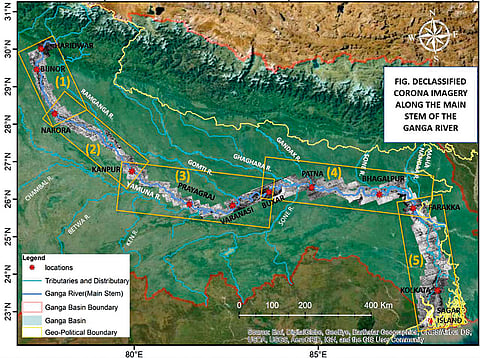
The NMCG, in collaboration with IIT Kanpur, has launched a pioneering study of the river’s long-term transformation. Rare Corona satellite images from 1965 are being compared with high-resolution imagery from 2018-19. Together, they reveal how barrages, embankments, cities and agriculture have reshaped the river over five decades. The findings will help planners identify stretches where the river can be restored to a more natural, ecologically balanced form.
Advertisement
An advanced Web-GIS platform is being developed to map land use, river morphology and basin changes, with data hosted on Google Earth Engine for easy analysis. Digital decision-support systems are being created for nine key locations, from Haridwar to Farakka. Aquifer mapping in Prayagraj has already improved groundwater recharge, supporting Aviral Ganga. The discovery of a 200-kilometre-long buried ancient river in the Ganga–Yamuna doab, has also opened new insights.
GIS-based Drain Dashboard
The Empowered Task Force recently met to review the implementation of the integrated drain-monitoring initiative under the Namami Gange Programme, including the development of a GIS-based Drain Dashboard for the GKC. High-resolution aerial and drone surveys along the Ganga main stem in Uttar Pradesh have generated precise geospatial datasets, now being integrated into a live dashboard with 2D and 3D visualisation. This platform combines LiDAR-based scientific data with visual inputs to enable basin-level pollution monitoring.
In the meeting of the ETF, Jal Shakti minister C.R. Paatil stressed field-level validation by District Ganga Committees and stronger inter-departmental coordination for drain-based pollution management.
The NMCG is also introducing CCTV-based real-time surveillance of Sewage Treatment Plants, integrated with AI-enabled feature extraction and a centralised monitoring dashboard. This visual monitoring layer complements existing Online Continuous Effluent Monitoring Systems (OCEMS).
Gyan Ganga Initiative
The Mission also aims for river-focused education under its Gyan Ganga initiative. This includes post-graduate programmes, short certification courses, and fully funded degrees like the MSc in Freshwater Ecology and Conservation at the Wildlife Institute of India. These programmes train professionals and communities in river science, conservation and sustainable management.
It’s a Mission Possible
The Ganga reflects the impact of these interventions. Water quality monitoring shows an improvement in Biochemical Oxygen Demand (BOD) levels, an indicator of organic pollution. In Uttar Pradesh, BOD levels have fallen from 10–20 mg/l in 2015 to a healthier 3–6 mg/l by 2022.
The Mission has now been extended to March 2026. The target comprises a cumulative sewage treatment capacity of 7,000 MLD by December 2026.
Guarding the Ganga
The story of Namami Gange is one of patient renewal. For a river shaped over millennia cannot be restored overnight. By strengthening institutions, grounding decisions in science, and drawing people into the process, the mission has created a framework that endures beyond timelines.
As the mission moves towards river-sensitive planning, its significance grows deeper. In caring for the Ganga, Namami Gange offers more than a cleaner river. It offers a model of coexistence, where development flows in harmony with nature.