Government may factor EV power consumption into emission compliance calculations.
Proposed CAFE III norms challenge zero-emission status for electric vehicles.
Policy links vehicle efficiency with India’s coal-heavy electricity generation mix
EVs May Lose Zero-Emission Tag Under CAFE III Rules — Here’s Why
Proposed CAFE III norms could redefine how EV emissions are calculated

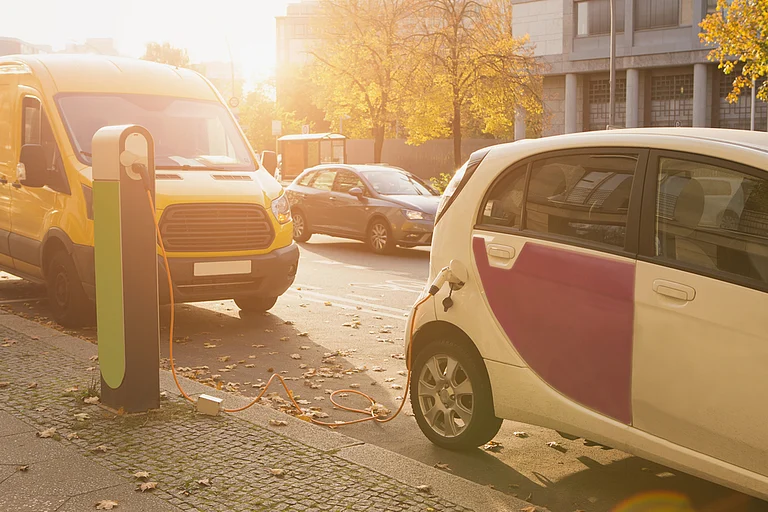
Electric vehicles charging at a public EV charging station in India
Summary
Advertisement
Electric vehicles in India may lose their zero-emission status under proposed fuel-efficiency rules, a step that could force automakers to make these eco-friendly vehicles more energy-efficient.
Citing the proposal, The Economic Times reported that automakers will have to factor power consumption while making compliance calculations for electric vehicles (EVs). Emissions from such vehicles will be determined by converting energy consumption (kWh/100km) into a petrol equivalent (litres/100km).
“This mandate on electric car makers will encourage more energy efficient EVs,” a senior official told ET. "This means future EVs will need to go longer distances with lower energy consumption to ensure car makers do not face penalties. While EVs have zero tailpipe emissions, they do consume energy which should be conserved."

Carmakers Seek Regulatory Relief
Carmakers will be able to introduce a variety of battery-powered models and obtain super credits to offset higher emissions from their ICE portfolio, even with limited sales, if EV emissions are marked at zero.
Advertisement
Until January-end this fiscal year, coal-fired power plants in India generated 1056.43bn units (BU) of electricity. It generated 137.51 BU from solar and 94.81 BU from wind sources during the period. If finalised, the proposal would run contrary to carmakers' demand to peg EV emissions at zero in the proposed Corporate Average Fuel Efficiency (CAFE) norms. While CAFE norms were initially aimed at reducing petrol and diesel consumption, their relevance in curbing vehicular CO2 emissions has grown.
Balancing EV Push & Grid Reality
In order to reduce upfront costs and increase manufacturing, India's transport decarbonisation strategy has so far mainly depended on accelerating EV adoption through programmes like the Ministry of Heavy Industries' Faster Adoption and Manufacturing of Electric (&Hybrid) Vehicles in India' (FAME India) Scheme, Production Linked Incentive (PLI) Scheme for Automobile and Auto Component Industry in India (PLI-Auto), Production Linked Incentive Scheme on National Programme on Advanced Chemistry Cell (ACC) Battery Storage, PM Electric Drive Revolution in Innovative Vehicle Enhancement (PM E-DRIVE) Scheme, PM e-Bus Sewa-Payment Security Mechanism (PSM) Scheme and Scheme for Promotion of Manufacturing of Electric Passenger Cars in India (SPMEPCI).
Advertisement
According to a study published in the journal, World Electric Vehicle Journal, experts counter that a more comprehensive approach to policy might result from tying EV efficiency requirements to grid emissions. Rather than shifting emissions upstream to coal-dependent power plants, electrification may result in deeper, system-wide carbon reductions if vehicle efficiency and cleaner power generation are integrated as India grows its renewable capacity toward its 500 GW non-fossil fuel target by 2030.