

Extreme heat is no longer just a seasonal emergency but a long-term urban planning and development challenge for Indian cities.
While Heat Action Plans and early warning systems are in place, cities still lack spatially targeted tools to prioritise neighbourhoods and budget for interventions.
Experts call for worker-centric heat stress metrics, low-cost cooling shelters, and an integrated approach combining cool roofs, tree cover, and affordable cooling solutions.
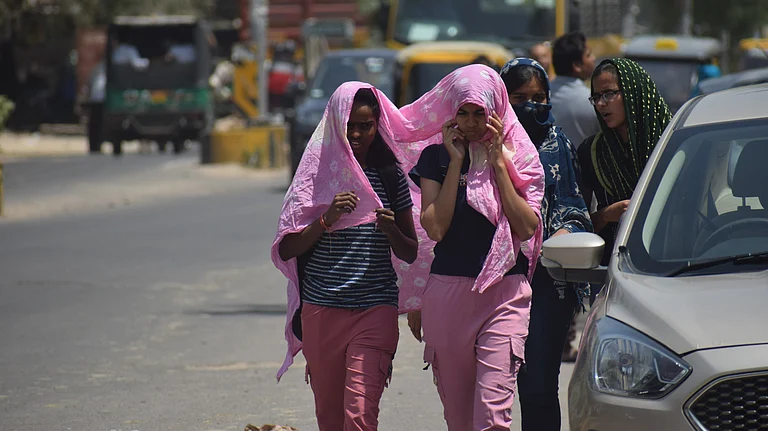
Large parts of India are once again under heatwave warnings. Over the last few weeks, temperatures climbed close to 48°C in parts of North India, while the India Meteorological Department warned of severe heatwave conditions across northwest, central and eastern India. Orange and red heat alerts activate a variety of response measures, including dedicated heat wards in public hospitals, drinking water points and mist stations in crowded areas, and changes in timings for construction work.
The 16th Finance Commission has also recommended that heatwaves be included in India’s list of nationally notified disasters — acknowledging extreme heat as a growing climate risk. Studies project that humid heatwaves in India could increase eight-fold under 2°C warming by the end of the century — dramatically increasing risks to public health and labor productivity.

1 June 2026
Get the latest issue of Outlook Business

Beyond Emergency
Heat planning, once treated as a seasonal emergency response, is now itself in the hot seat. The real challenge is no longer whether India recognises extreme heat as a crisis. It is whether our response can move beyond fragmented advisories and short-term interventions towards a model of integrative sustained effort for heat resilience.


Important progress has been made over the past decade. Heat Action Plans (HAPs) are being developed across states and cities, heat officers are being appointed, and the National Disaster Management Authority (NDMA) has issued detailed advisories and guidelines. Early warning systems and emergency response mechanisms are increasingly embedded into local governance processes.
However, heat risk varies dramatically within cities. Informal settlements, dense built-up areas and neighborhoods with low tree cover often experience substantially higher heat stress than surrounding areas, with lower adaptive ability for heat resilience. This requires differentiated planning responses. Most heat plans still struggle to answer practical implementation questions: Which neighborhoods should be prioritized first? How many cooling shelters, cool roofs, or trees are needed? And how should cities budget for them? How do we think about tradeoffs, when budgets are limited?

The next phase of heat resilience planning must therefore move beyond broad guidance documents toward actionable and spatially targeted decision-making. Cities need tools that can translate climate and socio-economic data into planning decisions. Platforms such as CHAITRA aim to bridge this gap by combining satellite imagery, land cover data and population exposure to estimate which interventions are needed where, and at what scale.
Heat preparedness must also become more people-centric. Current heat warnings are largely based on environmental conditions such as temperature and humidity. But for millions of outdoor workers, physiological heat stress depends strongly also on physical exertion causing high rate of metabolic heat generation, and exposure to sunlight. A construction worker carrying bricks in direct sun experiences heat very differently from a shop keeper working seated in a shaded indoor environment. Metrics such as India Energy & Climate Center (IECC)’s Extended Heat Index-N (EHI-N) attempt to capture this reality by incorporating work intensity (varying levels of METs, or metabolic equivalent of tasks) and sun exposure into heat stress assessments. Such worker-centric metrics could help trigger differentiated warnings and targeted protections for vulnerable groups including construction workers, street vendors, sanitation workers, and delivery personnel.
Cities are also experimenting with adaptation measures such as cooling shelters at transport hubs and public spaces to provide critical relief during extreme heat events. But with limited municipal budgets, these cannot become expensive, energy-intensive assets. India instead needs low-cost, low-energy cooling shelter models adapted to different climate zones, alongside strategic repurposing of existing infrastructure such as schools and anganwadis during heat emergencies. Philanthropy could support testing various prototypes using different design approaches and evaluating effectiveness across climate zones before scaling up.
Similarly, cool roofs have emerged as one of the most scalable urban heat interventions. Yet their effectiveness depends not only on individual implementation but on neighborhood-scale adoption and maintenance. Long-term resilience will also require scaling affordable, thermally efficient building materials, particularly informal housing where indoor heat exposure can remain dangerously high through increasingly warm nights. Access to low cost and sustainable cooling is a large piece of the puzzle too. Making progress on multiple interventions would result in a virtuous cycle, reinforcing positive effects. For example, increasing tree cover would reduce urban heat island effect, which would reduce peak electricity demand for cooling and workload on hospitals during heat events. State and city agencies will need ongoing capacity building and coordination mechanisms that allow heat resilience to become embedded within broader urban planning.
As weather patterns shift, extreme heat has become a defining development challenge for Indian cities — one that will increasingly shape public health, economic productivity and the livability of urban India itself. An integrated approach to heat resilience would ensure the impact is larger than the sum of its parts.
(Shruti Deorah is Executive Director of the IECC at the Goldman School of Public Policy, UC Berkeley, while Ashok Gadgil is the Head of Research for Climate Resilience at the IECC. Views expressed are personal.)